Friday, May 18, 2018

Week of May 14th-18th

TA’s Notes:
***Please do not send in any food to be shared among Voyager students***
***Please notify us if your child has strep.  Thank you for this courtesy.***

Voyager Homework Club- Tuesdays (2:00-3:30pm) and Wednesdays (3:00-4:30pm)
Dates to Know:
  • May 24th - 25th: 8th grade Overnight to Ridin’ Hy
  • May 24th - 5th & 6th graders, Rokeby Museum Field Trip
  • May 24th - 7th graders, Walking to Adams Market (12:00 - 2:45pm)
  • May 25th - ECHO Field Trip (Grades 5-6, 9:30 departure)
  • May 25th - 7th graders, UVM Ropes Course Field Trip
  • May 28th - No School (Memorial Day)
  • May 30th- 8th graders World Language Final Exams 8:10 - 10:30am
  • June 14th - 8th grade Graduation 6:30pm (Last day of school for 8th graders)
  • June 15th - ½ Day, Last day of school

Math 5:
This week we dove head first into understanding the concepts behind the Factor Game, played last week.  We spent some time this week, replaying the game, and then trying to solve Rivka’s problem - she always loses. We analyzed advice some of her friends gave her about things we can say are true about numbers and identified those truths as properties.  Properties make each number unique. Evenness, oddness, primeness, compositeness, abundance-ness, deficient-ness, perfect-ness, and squareness all make numbers unique and different from other numbers. We also decided that a number’s factors, make that number unique. This is true for its specific set of multiples.  We then talked about the Product Game, that reinforces knowledge about factors and multiples of numbers. We had a lot fun playing, but also trying to understand numbers in a more sophisticated way.

Students have a year-end math project to write a children’s book about a number they have chosen.  This sounds difficult but I have lots of great examples to show them of ways that students have captured a number’s uniqueness in a children’s tale!  The description of the assignment will be reviewed and posted on Google Classroom next week!

Math 6:
Students have rounded a very extensive unit on algebra this week and I have to say, I’m disappointed that the SBAC test isn’t happening now!  I am totally amazed at the breadth and depth of learning in this unit. As proficiency was reached, I extended a fair amount into 7th grade learning, with has raised the ceiling of understanding for all, especially those who were ready for it!  The culture and learning attitudes and beliefs held by students in this class is amazing. They have come a really long way!

Last review day for Variables and Patterns is Monday and then the final assessment will be Tuesday.  


Science ⅚:  
Our pursuit to understand the inner workings of Grand Prismatic Pool phenomenon has landed us in Physical Science, Earth Science, and soon to come, Life Science domains.  Students have asked why don’t you just tell us what is going on there, rather than making us figure it out. That is the hard work of learning and sometimes, it feels easier to them, than having to do all the work of thinking about it.  All I have to say is...we should just take a field trip there! Then they would know why it is so important that they understand the science behind the phenomenon!

Anyhow, students looked specifically at the behavior of hot and cold fluids this week, water in particular and worked towards generalizing this to the pool.  We noticed that when water is hot, the molecules move faster. This weakens their bonds to other water molecules, so they spread out. This also makes them less dense, so we have a ‘rising’ action.  We looked at three phenomena this week, why cold water stays below hot water in a graduated cylinder; why rice when boiled rises and falls and rises and falls. And why hot water molecules rise, move across the surface of the water, cool and sink to the bottom of a tank and then do this over and over in a cycle.  We named this behavior, a convection current. Because we have learned about the Earth’s interior, we know that the mantle is a hot liquid too and might have the same behaviors as hot water. Stumped by what causes an earthquake, some believe that maybe the earth’s crust shakes because of this moving, liquid mantle!  Hmmm...I think we are onto something. And since Yellowstone has 1000-3000 earthquakes each year this might tell us something about what might be happening under the ground in Yellowstone. In fact, the mantle is emerging up into the crust, due to crustal movements and is the cause of the hot water in the Grand Prismatic Pool.  Students are beginning the modeling process and took a quick quiz this week.


5/6 Humanities

  • Students selected and made a plan to finish reading an independent book for an upcoming book talk.

  • Student completed an assessment to identify and explain the theme of Soldier's Heart by Gary Paulsen.

  • Our content focus was on reconstruction and the effects of the Civil War. We researched, compared, and discussed the amendments made to the constitution before and after the Civil War.
  • We also assessed the different plans put in place during reconstruction and the aftermath once the reconstruction program was discontinued. We used actual contracts between freedmen and bosses to consider if life after the Civil War was better or the same for former slaves.

We have two field trips next week. ⅚ Students will be going to Rokeby Museum to study the underground railroad and ECHO for a science program. Please look for permission slips to sign.

7&8 Humanities

ELA: Students worked on learning about antecedents and pronouns. These can be tricky, especially due to the singular indefinite pronouns, such as each, everybody, anybody, etc. Students practiced these through online quizzes, reading log 33, and IXL C.1 and C.2. We also looked at explaining a quote through by using details and elaboration. Students continued their independent reading progress. Most students have reported reading far more this year than at any other times in their lives.

SOCIAL STUDIES: Continuing our study of world religions, students double checked their research results with facts provided to them. On Wednesday, we were lucky to have a representative from Shambhala meditation center in Burlington, Pat Rivers, join us to present about Buddhism. Ms. Rivers was an engaging presenter and we all learned a great deal about Buddhism through her presentation and activities. Students will have our final presentation from a guest speaker regarding religion on Monday, when an Imam from The Islamic Society of Vermont joins us to speak about Islam. We were very fortunate to have a representative from each of the five religions we studied join us in person to present and interact with us. The students have been excellent in designing and asking great questions during these sessions.

CMP7
This week the students have made great strides in understanding linear functions.  We have investigated x,y tables to look for patterns that show linear relations. Taking situations like walkathon pledge plans we learned what a coefficient in front of a variable represents and what a y-intercept is.  We have practiced graphing and “plugging and chugging” coordinate pairs to find out if they are solutions for our function. Students also began to look at the slope of a line as the ratio between vertical change and horizontal change.  

CMP8
This was a challenging week!  We began our “It’s in the System” unit with reviewing the parts of a linear equation in y-intercept form.  The standard form of linear functions was introduced and students worked to move from one form to the other.  All of this skill work brought us up to our first investigation using a linear system. We looked at how you can find a solution between the two systems by using a table and graphing.  Soon we will be able to find a solution by using an algebraic process.

Science
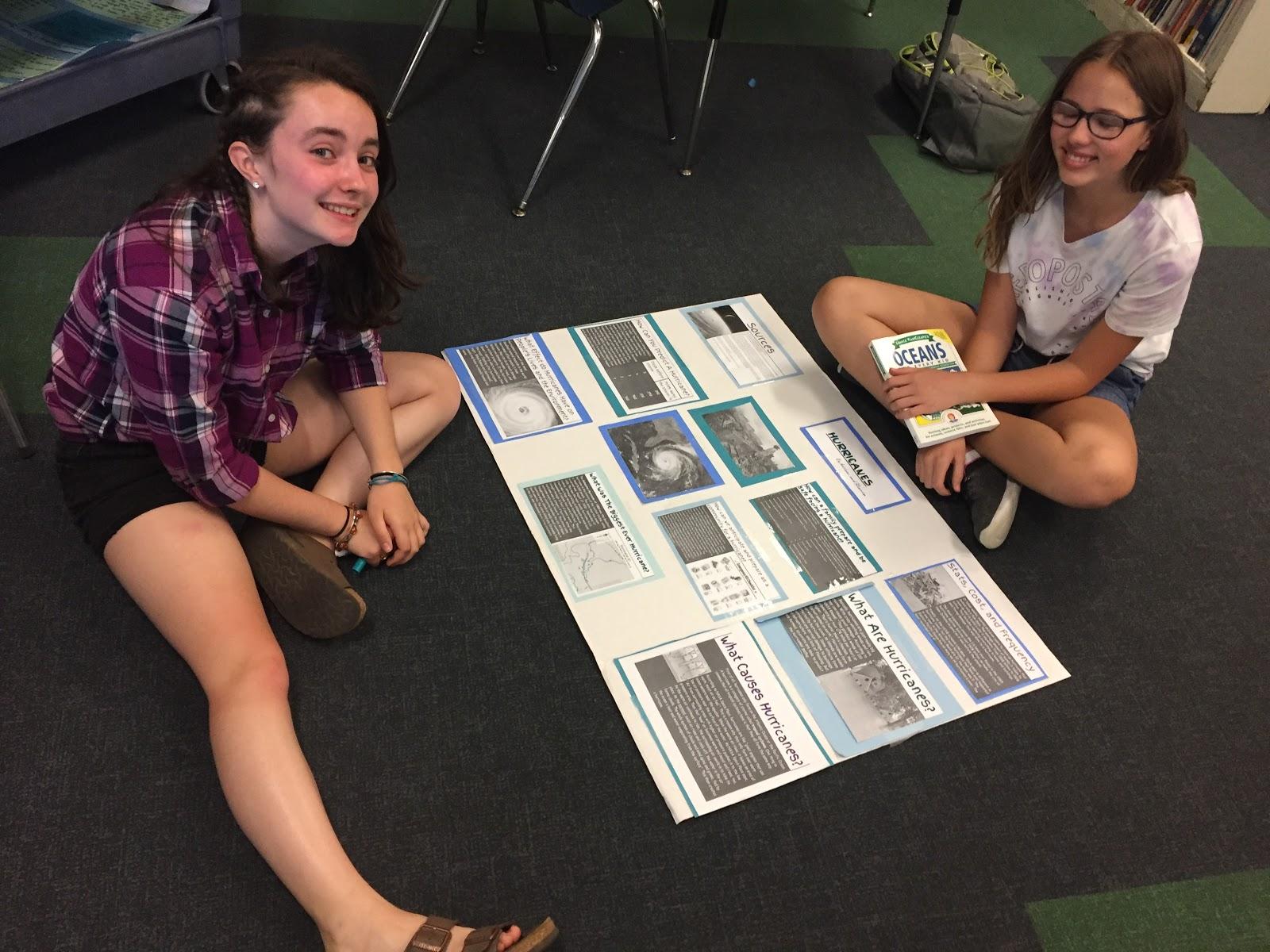
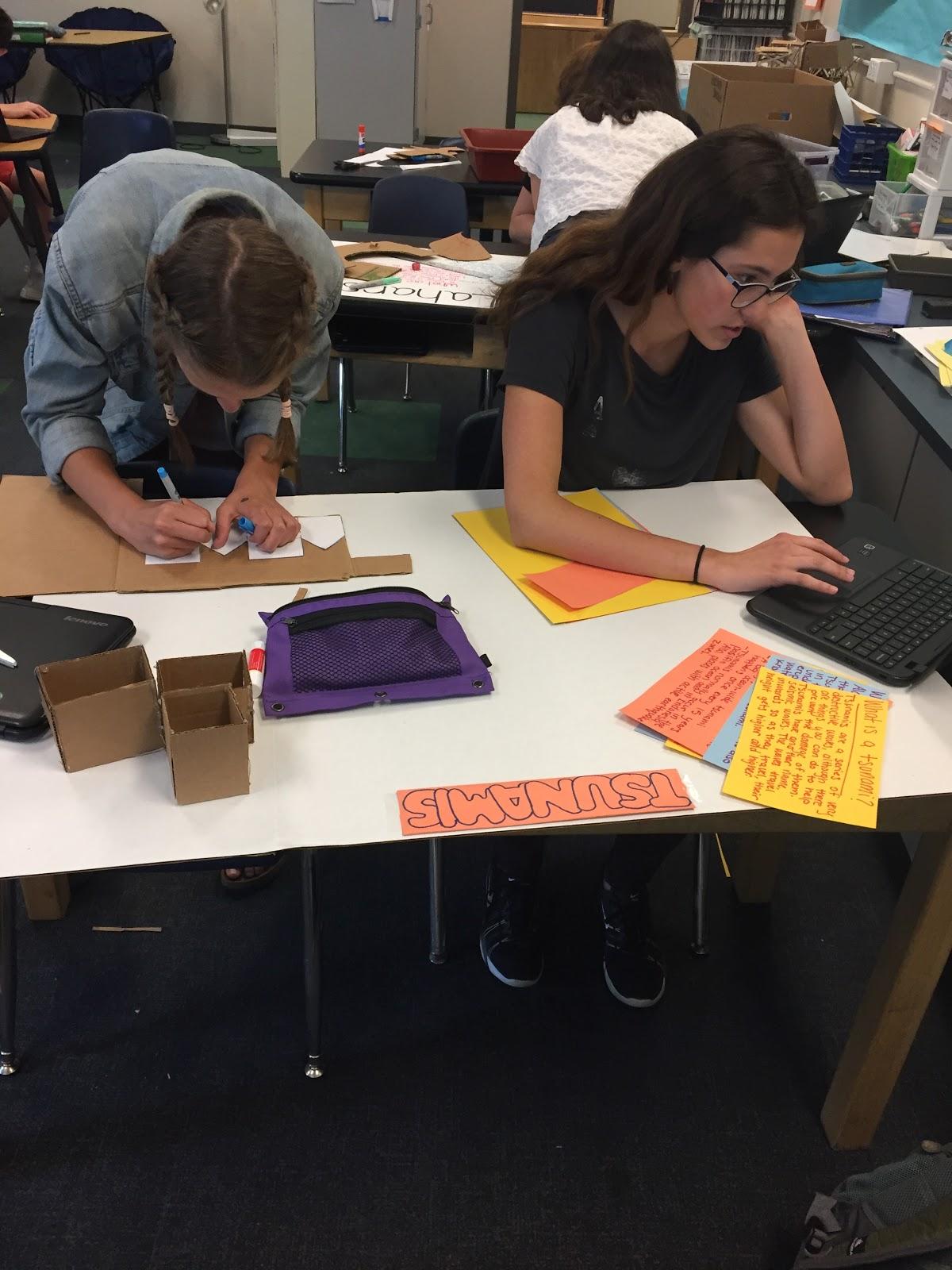
This week we completed our research on our natural hazards, created a visual and an interactive portion that we will share with our lower house visitors next week.






Friday, May 11, 2018

Week of May 7th - 11th

TA’s Notes:
***Please do not send in any food to be shared among Voyager students***
***Please notify us if your child has strep.  Thank you for this courtesy.***

Voyager Homework Club- Tuesdays (2:00-3:30pm) and Wednesdays (3:00-4:30pm)
Dates to Know:
  • May 24th - 25th: 8th grade Overnight to Ridin’ Hy
  • May 24th - 5th & 6th graders, Rokeby Museum Field Trip
  • May 24th - 7th graders, Walking to Adams Market (12:00 - 2:45pm)
  • May 25th - 7th graders, UVM Ropes Course Field Trip
  • May 28th - No School (Memorial Day)
  • May 30th- 8th graders World Language Final Exams 8:10 - 10:30am
  • June 14th - 8th grade Graduation 6:30pm (Last day of school for 8th graders)
  • June 15th - ½ Day, Last day of school

The Week in Mr. Merrill’s Room (⅚ Humanities):

Highlights:
  • Partner Read Aloud of Soldier’s Heart. Students continued to identify topics and record tier 2 words in their Reading Response Notebooks.
  • Brook trout stocking at Lewis Creek in Starksboro, VT (see pictures below). Students stocked 500 ten inch brook trout with Vermont Fish and Wildlife fisheries biologists. We also released our 85 brook trout fingerlings.
  • We took a look at the advantages and disadvantages for the Union and Confederacy leading up to the war. Students wrote a letter to an imaginary relative in 1861, explaining which side will win the war and why.
  • Divided Loyalties -  A classroom play. Students participated in a classroom play performance that highlighted how the Civil War divided families, setting brother against brother.
  • DRP Assessment: All students completed the Degrees of Reading Power assessment. Scores and more information about the assessment will be mailed home.


The Week in Ms. O’s Room (⅚ Math & Science):

Math 5:

Students began their very first unit of Connected Math this week by playing the Factor Game.  Student’s fluency plays a big role in this game, so keep up the fluency work. Still the 6’s -9’s are shaky, so please practice here and there.  A ten minute ride in the car can make a big difference? What is 9 x 6? How about 7 x 8? Looking for accuracy first, and then with time, speed!

After that, we’ve had very little math. We used the time to SBAC science test, but now that this is complete, we will move back into full time math!

Prime Time, our new book should be completed by year’s end.

Math 6:  

Students have been working hard on equation writing and seeing patterns in how terms in an equation, pop up in tables, graphs, and visual patterns.  There are some really good habits in place, where students are seeing that looping a set of data (see below) might reveal the rate, or coefficient of the variable.  

We agreed upon these ideas:
  • The rate is the coefficient, the coefficient is the rate.
  • Looping data (a less fancy way of saying “finding finite difference) helps reveal the coefficient.
  • Find the value for y when x is zero seems to help us with equation writing.
  • Data with constant rates will graph as a line.
Next steps are to work on:
  • The higher the coefficient the steeper the line.
  • The value of y when x is zero seems to be where the line crosses the y axis
  • There is more than one way to write an equation for a given pattern.
  • Order of operations proficiency.
We will be wrapping up Variables and Patterns and prepping for the final assessment next week.


⅚ Science:

We actually got a lot of science in this week, despite science SBAC testing. We used the spaces in between.

Focal points for discussions:
What do we know about the Grand Prismatic Pool?  That the fog above the pool is condensation. To trace the roots of the condensation, we need to go to the pool of water, which Ms. O revealed was hot and deep.  Molecule movement is heat energy and we measure heat energy with temperature. Therefore the hot water in the pool must have a lot of heat energy and thus the temperature is hot.  As these molecules move faster and faster, they vaporize. This vaporization could be evaporation or boiling, but either way, the liquid water molecules change into water vapor, or gas molecules.  As those liquid molecules vaporize and then cool, they condense or change back into liquid from a gas.

Our next steps are to consider how this pool of water is heated.  Some students made claims that a volcano is heating the water, while others believe it is the sun’s heat that causes this vaporization.  Thus our next pursuit, to look at the earthquake data in Yellowstone, to figure out why they have so many. We had fun talking about P and S waves, and how they are like light energy and sound energy in terms of their speeds and how this helps us detect earthquakes.  The next step is to determine why earthquakes happen! This will be our plunge into the earth’s interior.


The Week in Mr. Roof’s Room (⅞ Humanities):

ELA: This week, students really focused on participles. You know,  those tricky verb-type words mostly ending in -ing and -ed? Yeah, tons of fun. Very important words, and our students are doing well with identifying and using them in sentences. We did a few online quizzes to strengthen our skills. We also took the degrees of reading power assessment (aka DRP). Those are scored, and results will be shared at a later date.


The Week from Ms. Q’s Room (⅞ Math & Science):

CMP8
This week we completed our overview of quadratic functions with using algebra tiles to model factored and expanded form of quadratic equations. This is an area model.  The outside is the factored form and the inside is the expanded form.
We also learned how to transform parabolas from the parent function of y= x2  to a different location, direction and rate of change (fat or skinny)  y=-.5x2 + 3  The negative sign reflects it, the .5 is a slower rate of change, so it is wider and the + 3 moves it vertically up 3 units.
Students finished the week with an assessment.  Next week we are moving on to systems of linear equations with the book. It’s in the System.

CMP7
The 7th graders have been working with all sorts of models to show linear relationships.  We have utilized graphs, tables, equations and mobiles. In this model you need to figure out what number each symbol represents.

Students are learning to create equations from tables and have begun to understand negative slope, what a y-intercept is and the difference between direct variation equations and those that have a y-intercept.  

Science 7th/8th
Our science class has been feverishly finishing up our engineering lab reports.  It has been very sad that we have not been able to complete our experiments with the shake table.  However, we are doing our best to speak to the qualitative observations that we made during our testing process.  The lab report was handed in on Friday and we are beginning our final unit on Natural hazards.

Saturday, May 5, 2018

Week of April 30-May 4

TA’s Notes:
***Please do not send in any food to be shared among Voyager students***
***Please notify us if your child has strep.  Thank you for this courtesy.***

Voyager Homework Club- Tuesdays (2:00-3:30pm) and Wednesdays (3:00-4:30pm)
Dates to Know:

May 8th - ⅚ Brook trout stocking on Lewis Creek in Starksboro, VT. Date Tuesday, 5/8. Permission slips and more details to follow.  Field Trip Form HERE

May 28th- No School

The Week in Mr. Merrill’s Room (⅚ Humanities):
Highlights:
  • We kicked off our Civil War unit by exploring what we already know and want to know about the Civil War.
  • We started a read aloud of Soldier’s Heart by Gary Paulsen. As we read we are listing topics and big ideas that will help us discover the themes of the book.
  • We had several activities that were based on the division caused by the Civil War, both geographically and politically.
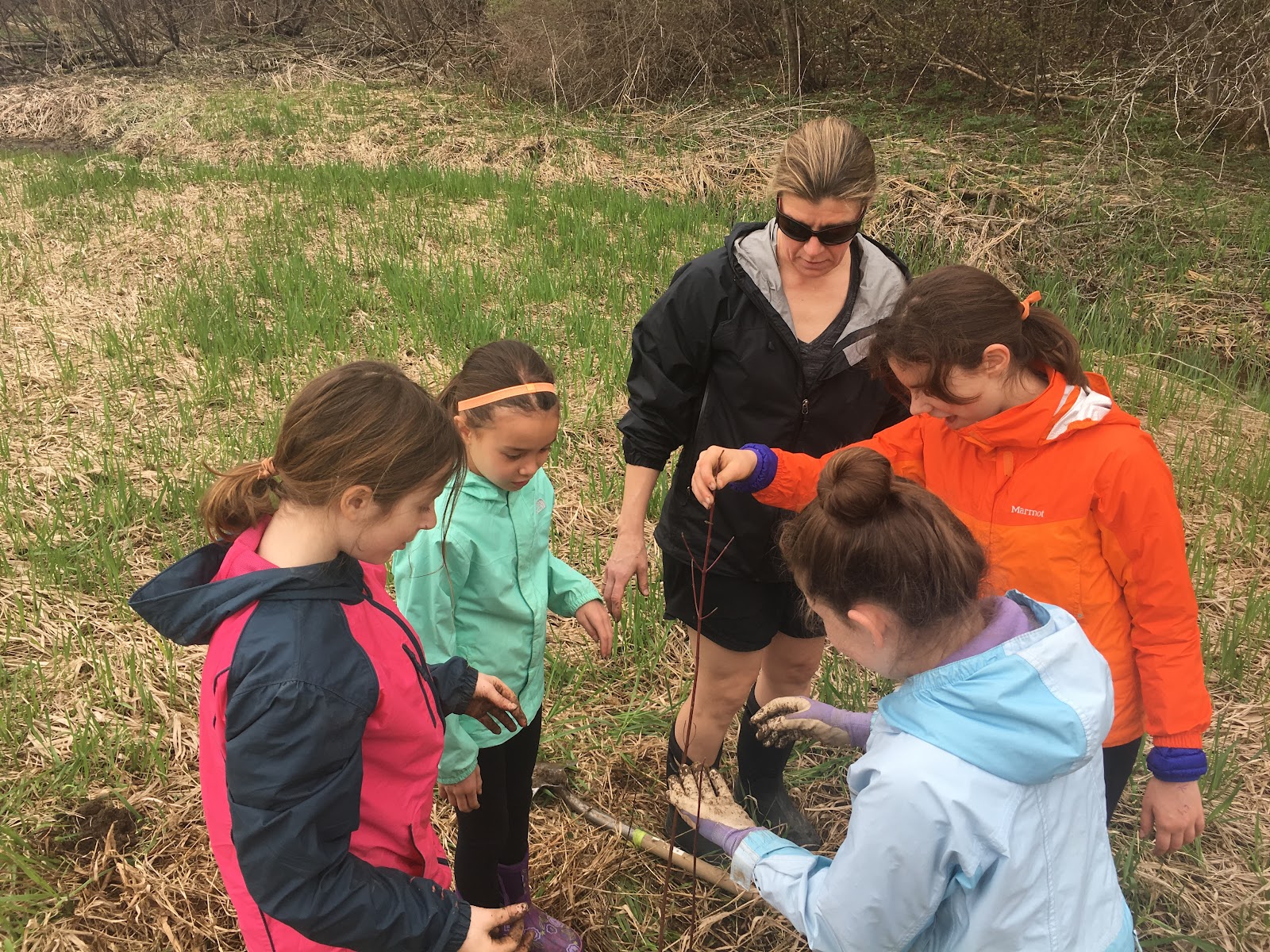
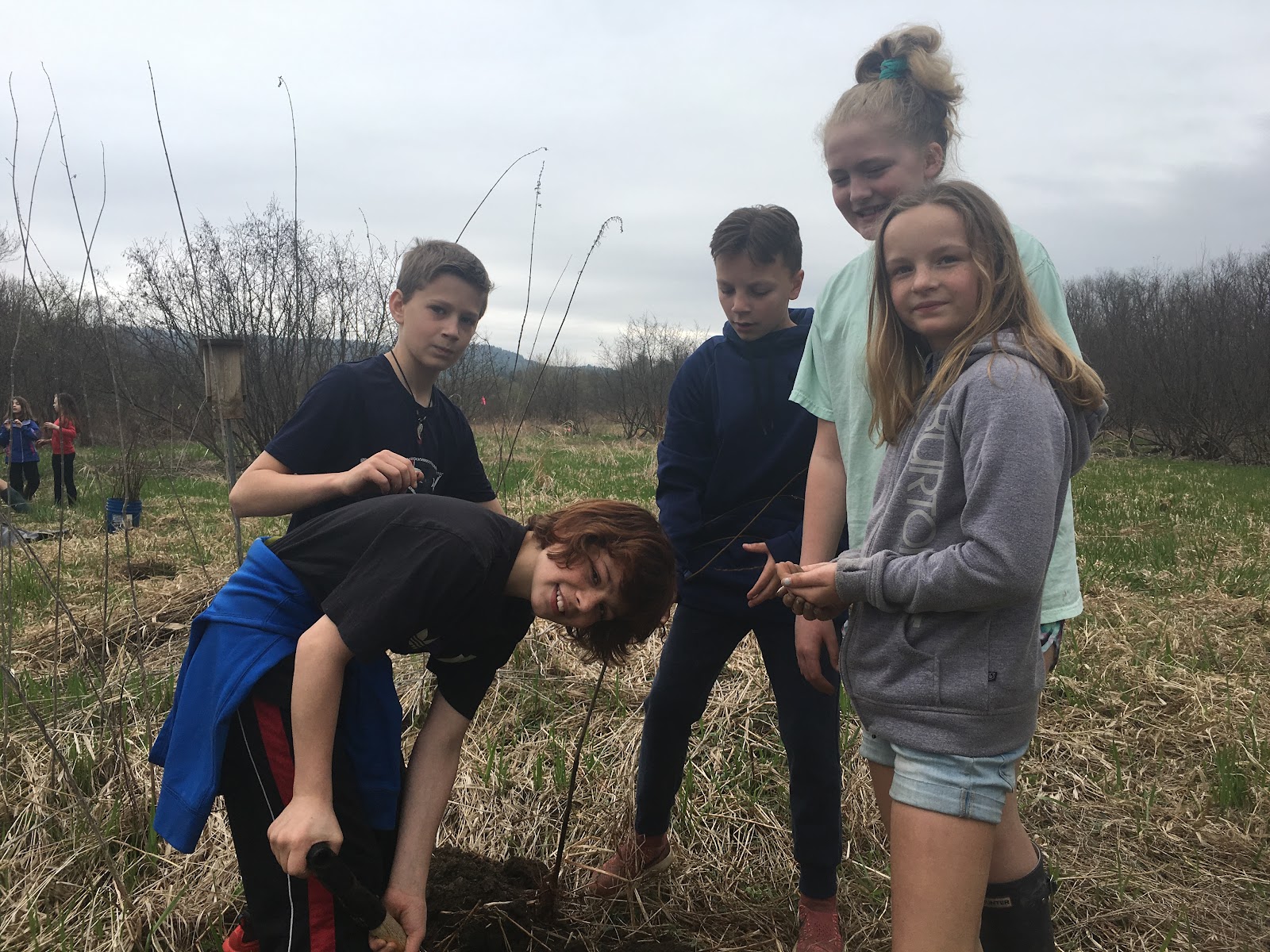
  • Tree planting along Allen Brook. Please remember to check your student for ticks tonight!


The Week in Ms. O’s Room (⅚ Math & Science):

Math 5:
Computational Fluency:  It’s never too late to practice the 6, 7, and 8’s!  Before our next big unit (Prime Time), I thought it would be important to put a little extra time into basic 0-12 fluency.  Many students made great progress this week, either with accuracy or speed.

Conversion: We spent this week talking about length as a measurement, and specifically focused on unit conversion of length (within the Metric and US Customary System).  Common Core sees this as an important skill and the focus of the conversion was around using ratio tables to convert. A worthwhile and useful application of multiplication.  

Math 6:  
Students spent the week designing their own individualized learning by focusing on standards that he/she has not met and taking responsibility for the relearning plan.  I did assess two different skills this week for each student, so you will see updated scores on Jumprope after this weekend.

We also are continuing the table, graph, and equation pursuit in algebra!  Students are beginning to see patterns in data, graphs and equations that will lead them to linear and proportional relationships, a prerequisite skill for Grade 7.  Students are making great connections and seeing similarities between equations and within equations, graphs and tables.


⅚ Science:
What explains the ‘fog’ above the Grand Prismatic Pool?  Students are in hot pursuit of explaining the Grand Prismatic Pool phenomenon and made a positive move in that direction this week by observing vaporization and condensation.  We heated water and watched both evaporation and boiling, examples of vaporization, and created conditions for condensation, so that students could see phase change. This model demonstrates the role that heat energy plays in phase change. In this model we could see that fog’ was created.  In addition, we poured water over dry ice to show ‘fog’ and I asked students if they believed that the fog in the pool is created because of hot or cold water. I then revealed the truth, the water is hot. The ‘fog’ above the pool can be explained as a phase change from liquid to gas. The ‘fog’ can then be explained by cooler conditions above the pool as a phase change from gas to liquid.  


We had an awesome time planting trees Friday!  Please do a tick check!


The Week in Mr. Roof’s Room (⅞ Humanities):


The Week from Ms. Q’s Room (⅞ Math & Science):

CMP7
This week we began our “Moving Straight Ahead” Unit with finding our average walking rate for 25 meters.  Through a series of steps students figured out what their walking rate was in miles per hour. We found out how many calories we burn based on our weight and walking rate.  We figured out how long we would have to walk to work off a McDonald’s Big Mac. For many, they would have to walk for at least 8 hours to burn it off. I hate to think what a pint of Ben and Jerry’s is!  We also graphed our different walking rates in Desmos, an online graphing calculator. Students are beginning to see the relationship between rate of change and the slope of the graph. We rounded out the week with solving all sorts of algebraic equations.  We are learning to keep things balanced.

CMP8
We began the week with a series of stations that looked at all things quadratic.  We explored triangular and square patterns, understanding the equation for a fixed perimeter of a rectangle, played with the different coefficients in a standard form, played with algebra tiles and learned the area model of going from factored form to expanded form. Next week we will finish our quick quadratic blitz with an assessment.

Science 7th/8th
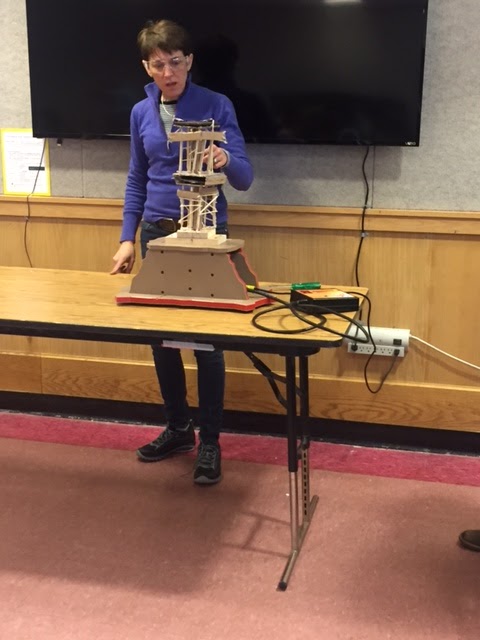
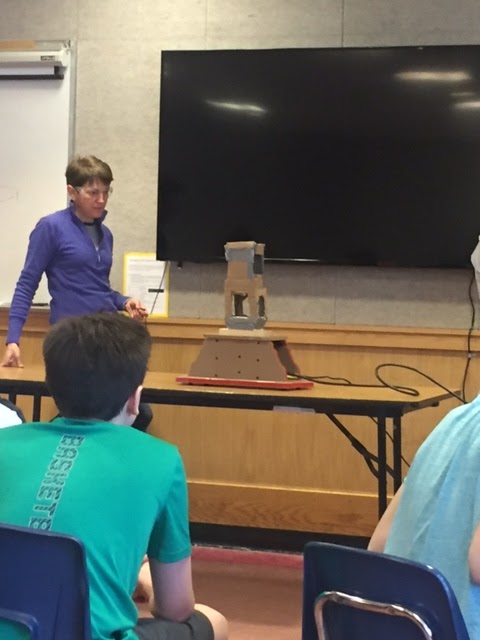
  Teams spent the first part of the week completing their earthquake proof structures.  We placed two 450 g weights at 15cm and 30 centimeters and then ran the earthquake shake table for over 20 seconds.  Some of the building designs were interesting and effective. We had cross bracing, use of trusses, dampers, tension wires and base isolation.  The structures were so well made that only a few showed signs of failing. Unfortunately, our shake table failed. We could not complete our testing due to an electrical malfunction in the device.  We are still hoping for a possible shake table from another source....until then we are beginning our scientific reflections on our work.