Saturday, April 18, 2015

Week of April 13


TA’s Notes:
The last day of school will be Tuesday, June 16th.  This will be a half day.
8th Grade Graduation - Thursday, June 11th, 6:30 PM

The Week in Mr. Merrill’s Room (⅚ Humanities):

We put the finishing touches on a couple of units this week. Students completed their final LEAF on our Historical Fiction unit. Students had to use examples of the main character’s actions, thoughts, and feelings and make personal connections; hence, what is it like to walk in someone else’s shoes (our focus question for the session).  I also announced the winners of the Stock Market Game. Many teams  invested heavily in the tech industry, which had a rough ride during our 10 week game.  Google and Apple certainly did not perform as many had hoped. Groups that had invested in entertainment (Disney) and the manufacturing industry (lower gas prices) did very well.
We used two class periods to prepare for the upcoming SBAC session. Students participated in a classroom activity which was background information for the performance writing task. Students used related text to read and respond to a variety of standard based questions.
We also spent some afternoon class time learning about the conflict between the New Hampshire Grants and the Yorkers. And we ended the week with a showing of Johnny Tremain, one of our book choices for historical fiction.
Note: Students that would like to submit writing (all genres) for the Scribe should send it to me on a word document as soon as possible.

The Week in Ms. O’s Room (⅚ Math & Science):

Math 5:  Students were exposed to two SBAC practice tests this week and this finalizes our work viewing the test prior to our actual testing dates on May 1.  In the midst of this testing we began investigation of fraction x fraction visual models. We will continue to work on this after the break.  Do some Moby!  It’s good for you!  One hour over the break!

Math 6:  Sixth graders have been very focused on this algebra unit, building some foundation skills for understanding equations.  The departure from the CMP 3 program was purposeful; to expose students to distributive property, which they will see in 7th grade and on the upcoming SBAC test.  We also did work on how to use our looping to write equations from patterns in graphs and tables.  More to come..One hour of Khan please!

Science ⅚:  This was our week to look more deeply at how matter changes and how we can characterize those changes.  So yes, we did do the baking soda and vinegar trick and others; watch your stashes of these things.  I failed to tell students that I once had a colleague who warned her students about doing these kinds of experiments at home.  The young man proceeded to fill a two liter bottle with baking soda, then poured in vinegar, and capped it.  When the bottle gained enough pressure from the chemical reaction, he dropped it and then the bottle shot up and hit him in the orbital bone, breaking it!  Large quantities of those two materials may result in a serious accident!  Anyhow, the students had some investigations in order to push a little on their understanding of physical and chemical change.  We will finish up this unit after the break.


The Week in Ms. Wesnak’s Room (⅞ Humanities):

A glimpse into the last two weeks in Humanities...
During our AM classes we have been focusing on the power of images, what makes a great slogan, and what makes a great ad. We started this mini unit by looking at images that are associated with advertisements and trying to figure out the reasoning was behind the choices made by some companies. We played with images as well by students bringing in pictures of their choice from magazines and newspapers. They were challenged to come up with slogans (using figurative language) and hashtags to promote the product. This was a really fun activity and really pushed the students to think about the picture itself and the story it could possibly tell. It also pushed the class to think about the choices behind a company’s advertising campaign. For example why would a gasoline company, such as Shell, use an image of a young boy flying a kite on a beach on beautiful day? Our discussions brought us to believe that perhaps Shell was using  the image to draw in the audience first with the image, which would then encourage them to read the full advertisement. After our work with pictures and looking at the top-rated print ads of the past year, we moved into the infamous “Pixar Challenge”. This activity is extremely popular as we use Pixar Shorts as our inspiration for creating advertisements for products showcased in the short film. For example, in the Pixar Short “Geri’s Game” the film features an elderly man playing chess against himself. Students were challenged to create an advertisement about chess using “Geri’s Game” as the potential commercial or image for the print ad. The slogans that were created were great and students had a lot of fun coming up with hilarious slogans, hashtags, and some... jingles! As we brought our Pixar Challenge to a close, we moved onto studying commercials. This week students were asked to analyze television commercials by looking for the different persuasive techniques that we learned last week. We watched and analyzed a variety of commercials looking at/for the following persuasive or advertising techniques: lighting effects, sound effects, music choice, filters used for images, celebrity endorsements, slogans, social media, figurative language, and more!! We also spoke about target audiences and what made commercials work or not work. Our final conclusions were: 1.) Commercials need to hit some kind of emotional chord: happy, sad, inspirational, funny. 2.) Commercials that work are between 30 seconds and 2 minutes in length. 3.) Not everyone will think some types of humor are funny, so be careful when using humor! Our commercial viewing day was super fun as students took on the role of commercial critics, ate popcorn, and gave commercials a 0-5 star rating and explained their reasoning. The end of our week was focused around students finalizing their business plans for the business convention and storyboarding their commercials! Students had to finalize their business name, product and product name, slogan, logo, and write a product description. With the finalizing of their business plans, we are now officially ready to go!!

During our PM time together students began to think critically about “stuff”. We started off by viewing “The Story of Stuff”, which is a film about U.S. consumption: where we buy things, where they come from, and where they go. It also teaches about the impacts of marketing and advertising and how it can impact a person’s happiness level! Students learned a lot of interesting facts such as, if everyone in the world consumed as much as the US we would need 4 more planets!! We also learned that America’s happiness peaked in the 1950’s!! These facts challenged our class and brought up great discussion. After watching this short film, students were asked to take a look in their own closets to find out where their own “stuff” came from. Each student made a list of 15 items and found out where they were made. We then tallied up our totals and discovered that most of our items came from countries in Asia or Central America. This data brought us to our next mini unit around the question of: How do we get our stuff? We decided to focus on t-shirts, as this is the most common item we all have, so we started to look at the life of a t-shirt to fully understand the process of how it gets into our hands from start to finish. Students started out by predicting the life cycle of a t-shirt and created skits to illustrate their thoughts. These of course were creative and funny! After watching the class skits, we used “NPR’s Planet Money: Life of a T-Shirt” documentary to learn more about the process. Through this short documentary we met two women who worked in factories in Bangladesh and Colombia. By being introduced to these women we began to learn more about the labor behind a t-shirt. We used multiple articles from Jr. Scholastic to help us learn about the different environments that people work in, and we also learned why our products are made in other countries. We discussed the pros/cons of what would happen if more of our products started being made in the U.S., and we also discussed the benefits to having factories built in countries in Africa which is becoming more and more popular. Students took part in really great discussions, challenged each other, and interacted with a number of texts to help in developing a global understanding. These topics certainly opened our eyes and also provided students with inspiration to develop and create change! Many were inspired by the videos, articles, and discussions, so they are applying new environmentally sustainable, humane, and ethical practices to their businesses for our upcoming Business Convention in June!! It has been busy, but certainly fun!

The Week from Ms. Q’s Room (⅞ Math & Science):

CMP8
  This week we dove into our new book called "It's in the System."  For the first time students began to explore algebraic equations with two unknown variables on the same side of the equation.
(Ax +By = C)  We looked at situations where two variables such as the profit from hat sales and the profit from shirt sales needed to equal a specific profit.  There are a multitude of hat and shirt combinations that will allow you to get at that profit and we explored how to create tables and graphs to illustrate the situation.  In the following investigations we investigated two related linear functions or systems to find the common solution or intersection between these two systems.  These problems asked students to recall all of their skill with balancing equations.  When we return we will learn more strategies for solving systems of equations.

CMP7
The  7th graders are at the end of "Moving Straight Ahead" and we are developing strategies for finding the linear equations in multiple ways.  Students will need to be fluent with moving from graphs, tables and sets of points to writing equations.  They also need to understand what parts of the equation such as the slope, y-intercept represent in the context of the equation.  Checking your solutions by plugging coordinate points back into the equation and finding the y-intercept when you have the slope and a point are other skills we are fine tuning.  When we return we will review for our MSA Unit Test.

Science7th/8th
How  can we conserve and learn how to use less of our natural resources?  How much waste do we create and where does our garbage go when we throw it in the can?  These and many other questions were explored this week.  As part of the Business Convention project, Science class has looked closed at defining what natural resources are, how each of us has an ecological footprint of resources we use and lots of waste we produce.  We  explored, talked about our sanitary landfill, the importance of reusing, recycling and reducing waste,and we went out into the community to pick up and classify the waste that get thrown around our community. As expected, plastic trash was the biggest portion of what was picked up.  When we return, science will be integrated into humanities as students begin to design and build their "product" prototype with special emphasis on the use of natural resources.  

Friday, April 10, 2015

Week of April 6th - 10th

TA’s Notes:
The Voyager Recycle Sale was a huge success!!  $1,508.92 was raised!
Thank you to all students and parents who helped volunteer their time for this event.  A special thank you to Leigh Samuels and Sarah Forbes for organizing everything and bringing it all together!!

Water Bottle Update:  If you are in charge of Opening Day, coaching a lacrosse team, or just in need of some hydration, we still have water bottles that need to go this year!  They are $6 a piece and they are really good bottles!  Please feel free to purchase a few more and ask friends or family if they would like one or two.  My son tried to con me into a 12$ look alike the other day because he liked the green. I told him he gets the green one that says, Get Your Tap On!  It’s a great deal and replenishes our budget which is in the red because of the purchase!  No pressure!  Thanks for considering another dozen, hint, hint!  Colleen

We have posted a link to the DC family meeting for 8th Grade parents. If you haven’t taken a look, please do!  It provides you with additional links to what to bring and what to expect!  I will be working over vacation to get some final things in order.  We will not get a picture with Senators, they are on recess the week we are there.  We will get to meet with some staffers on the steps though.  Too bad!  It will be super fun!  Can’t wait!  Colleen

Upcoming Field Trip Dates:
Thursday, May 14th - ⅚ trip to Lewis Creek and Lake Iroquois for trout release and water study.
Friday, May 15th - 5-8 trip to Spruce Peak Performing Arts Center for a special Flynn Theatre sponsored performance about WWII.
Friday, May 29th - 5-7 trip to Mt. Independence and Ft. Ticonderoga - late afternoon return time.

Permission slips, chaperon requests, and more details will be sent out after spring break. There is one other trip in the works - TBA.

The Week in Mr. Merrill’s Room (⅚ Humanities):
The spring schedule is starting to ramp up. Students completed an on demand writing assessment on Tuesday. This task is an informational writing activity to measure growth from fall to spring. Next week, we will be administering a reading assessment (called the DRP) to measure comprehension. We also had our first practice round for the upcoming SBAC assessment in May. Students practiced one of the three components of the assessment. We will be practicing the other two next week.  
We are wrapping up our historical fiction literature group round next week. Students will be using a LEAF note organizer to write a final LEAF. We are noticing that some students are not keeping up with the reading assignments which is making it difficult to have an effective book discussion. Students are expected to read for 20 minutes a night and have a reading assignment following every literature group meeting. Our next literature group round will be starting after vacation.
We had a great historical performance art activity for our afternoon block periods this week. A teaching artist from the Flynn helped us create an audio performance of the capture of Ft. Ticonderoga by Ethan Allen and the Green Mountain Boys. It was a very interactive academic and group learning experience.

The Week in Ms. O’s Room (⅚ Math & Science):

Math 5:  This is a two week update!  I have had this science and engineering class on Friday/Saturday for the last three weeks and it crushes my ability to get this out on time.  So sorry.  So, where are we?  We spent last week working on some SBAC prep.  We learned how to log in and answered some training questions.  This particular test was to prep students on the tools of the SBAC.  How to use a calculator, drag a point on a coordinate graph, etc.  They seemed to do okay with it.  We will have 2 more hours of orientation and practice before April 30.  We also began Unit 5; the focus is on multiplication and division of fractions.  Our work this week was to build a bank of strategies and compare them.  Ultimately we want to get to the point where we can find rules that work every time.  The focus this week is fraction of a whole and fraction of a fraction problems.

Math 6:  This is a two week update!  I have had this science and engineering class on Friday/Saturday for the last three weeks and it crushes my ability to get this out on time.  So sorry.  So, where are we?  We spent last week working on some SBAC prep.  We learned how to log in and answered some training questions.  This particular test was to prep students on the tools of the SBAC.  How to use a calculator, drag a point on a coordinate graph, etc.  They seemed to do okay with it.  We will have 2 more hours of orientation and practice before April 30.  Algebra is rolling in like a slow, easy riding wave!  We have been working on building tables and graphing and will now step out of Quadrant 1 and look at negative numbers on the coordinate plane, and how to write equations for relationships we see in tables and graphs.  This will introduce students to slope, y intercept and the linear equation.  We will keep it simple and successful!  Also, we did expose students to one step equations this week as a way to build this equation sense.

Science ⅚: Can matter change?  If so, in what ways?  Can it be lost or gained?  This is the focus this week.  We spent Monday and Tuesday looking at changes to matter and trying to say something about the kind of change that has take place.  The latter part of the week was spent discuss and proving the Law of Conservation of Mass.  There has been a lot of inquiry and we have had some variability in student’s ability to handle this hands-on exploration.  I have been a little naggy, but we have lost a couple of thermometers and beakers to accidental mishaps.  Accidents happen, but put a plug in for listening during science.  We will continue with the highly engaging work next week when we look at chemical reactions.

The Week in Ms. Wesnak’s Room (⅞ Humanities):

As the producer of this year’s school musical, my words for the week are...

GREASE is the word!!

I’ll catch up with everyone next week with a double issue on what has been happening in 7/8 Humanities!!!

The Week from Ms. Q’s Room (⅞ Math & Science):

CMP8
 This  week we developed strategies for finding solutions for quadratic expressions. This is the same thing as finding x intercepts and finding the roots of an equation.    We played Dr. Math and looked for errors that "students" made when solving multi-step equations; we exposed some common misconceptions along the way. We are moving away from "Say it With Symbols" and I plan to add a few questions to our next assessment that reviews the content we covered.  Next week we will begin a new unit called "It’s in the System".

CMP7
    The 7th graders played a game of Dr. Math like the 8th graders, but this time Dr. Math was trying to resolve errors in balancing algebraic equations.  We talked about the reasonableness of an answer and the misconceptions that happen when solving for an unknown variable.
    We took a trip around school to measure the rise and run of stairs as we explored the meaning of slope.  Creating a ratio between the rise and run of the stair we were able to mathematically compare the slope of the stairs to the regulated ratio that contractors are supposed to use when building stairs. The concept of the ratio between rise and run gives us the slope or “m” in our y= mx + b.  We hope to finish this unit next week.

Science 7th/8th
  What is a renewable resource and how can we find a way to create a sustainable system?  This week students read, completed vocabulary lists, and began exploring the dynamics of inputs and outputs on a natural resource system.  We became managers and lumberjacks for a small forest.  We explored what happens when you cut more than you replace and also creating a system that balances growth and harvesting.  With the roll of the die the forest was also impacted by ice storms, invasive pests, drought, but also warm, wet and sunny seasons.  We also had the opportunity to play some online sustainability games which included finding our ecological footprint, creating a sustainable household, fishing responsibly and creating a city that conserves and uses energy wisely.

Friday, April 3, 2015

Week of March 30th - April 3rd

 TA’s Notes:
8th Grade DC Trip Final Payments now due!

Get Your Tap On water bottles- selling out fast!  $6 each (Camelbak 24oz Podium)  E-mail me if you’d like any before they’re gone!

The Week in Mr. Merrill’s Room (⅚ Humanities):


 Students using the iPads to scan and read their peer’s websites


This week students finished up their Narrative Writing piece. Students spent the week revising and editing their work, with the help of peer editing, as well as teacher feedback. They had an opportunity to share their work with one another in small groups. Students also finished up their Revolutionary War unit. On wednesday and thursday, they went for a walk on the digital “freedom trail”, set up in the hallway. Students used QR codes and iPad readers to scan through and read their peer’s work. If you are in the building, please feel free to stop by and take a look yourself! The “walk” is set up at the end of the hall, across from the coat hooks. Use your smartphone, and the app qrafter, to scan your son or daughter’s website!

The Week in Ms. Wesnak’s Room (⅞ Humanities):

Our time in class was cut pretty short this week due to SBAC testing, but I wanted to be sure to give BIG kudos to our 7th and 8th grade learning community for persevering through this testing window. We saw great work from all of our students as they worked through the Math and English/Language Arts tests and performance tasks. At this point the majority of our community has finished ALL of the testing. If students have not finished they will have time to complete their missed tests on Monday and Tuesday of next week.

At the start of the week, during our morning classes, we started our marketing and advertising unit with a few lessons on figurative language. We started off learning about similes and metaphors. We defined these terms and then took a look at some examples in pop culture. We discovered that similes and metaphors are all around us! They are in songs, television, and in movies! After singing along with some pop hits and watching clips from movies such as,The Wizard of Oz, students were able to identify many metaphors and similes from their everyday lives that they may have never even noticed! The next time we met students were introduced to 4 more types of commonly used figurative language: hyperbole, alliteration, personification, and onomatopoeia. We found many examples of these in speeches, movies, and of course advertising! As figurative language is used to create vivid and imaginative images in the minds of the audience (buyer, reader, etc.), our next step will be to actually look at some images in advertising and marketing! Next week we will be discussing the power of images. The saying, “A picture is worth 1,000 words” will be our guide as we examine the stories, sayings, and persuasion that can be told through an image or series of images. We will be looking at and analyzing logos and slogans of many popular companies.

During our afternoon time together on Monday and Tuesday, students took a deeper look at the story of, The Lorax. To start our economics unit students were asked to make connections to 3 things: humans, environment, and economy. The questions asked to the class were: How do these 3 things connect to each other? How do these things hurt each other? How do these things help each other? This discussion was the kickoff to our unit, and what better way to illustrate this than by dissecting the deeper meaning between the lines of a classic, The Lorax. Students watched the original cartoon version of The Lorax and were asked to keep track of examples of how the environment, the economy, and humans work with or against each other. Once the viewing was complete students worked with their table groups to answer questions such as:
- What are some lessons we can learn from The Lorax?
- What does: the Lorax, the Once-ler, and the Thneed represent?
- Was the Once-ler a good guy or a bad guy? How did he change or make an impact on the environment in The Lorax?
As we discussed these questions, and many more, the students were left with an ethical decision to make for the upcoming creation of their business for the Voyager Business Convention (taking place in June). They were asked to think about whether or not their business will be a “Lorax” type business or a “Once-ler and Thneed” type business? Is that good or bad? Is there a way to have both? These questions will help to lead students into thinking about the philosophy and ethics behind their business. It will also lead students to think about how their decisions may impact future business decisions, their employees, or the community/environment their business is a part of. Although the story of The Lorax has been told many times, students left class with their heads full and brains bursting with ideas, big questions, and a new perspective on what it takes to build a business and the impact it can have.

The Week from Ms. Q’s Room (⅞ Math & Science):

CMP8
Due to SBAC testing we had a very brief week of math in the traditional sense.  Students worked very hard on their Math 8 SBAC summative and performance task.  They showed perseverance and focus. Kudos to our 8th graders! We have been working on finding solutions to multi-step linear equations by using the distributive, commutative properties and discovered strategies for being more mathematically efficient.
CMP7
Due to SBAC testing we had a brief week in 7th grade math also, however there was a lot of math being done.  The 7th graders performed the SBAC math summative and performance task.  They were focused and diligence.  Kudos to our 7th graders! At the beginning week, we did some more investigation into inequalities, how they are written and graphed.  We looked closely at linear inequalities and compared them to equalities.
Science 7th/8th
Students set up their light stations again on Monday to finish out our investigations on the properties of light.  On Tuesday, students worked on a summative assessment that pulled together their understanding of all the light concepts we explored.  After SBAC testing we will be moving in a new direction.

Friday, March 27, 2015

Week of March 23

TA’s Notes:
8th Grade DC trip money is due April 1st!  The final cost is $285.00.


After school with Ms. Sherman:


The Week in Mr. Merrill’s Room (⅚ Humanities):


This week, students spent a lot of time working on their Narrative Writing pieces. Their writing pieces are very strong, and students have been having fun using their creative skills to write inventive and interesting pieces. We will finish them up next week, as students get feedback from their peers, make edits, and self assess. For the Revolutionary War, students have been working hard on researching their group topics. Next week, they will finish up their google sites dedicated to their topics, and they will walk along their “freedom trail”, using iPads and QR codes to make their sites come alive!


The Week in Ms. O’s Room (⅚ Math & Science):


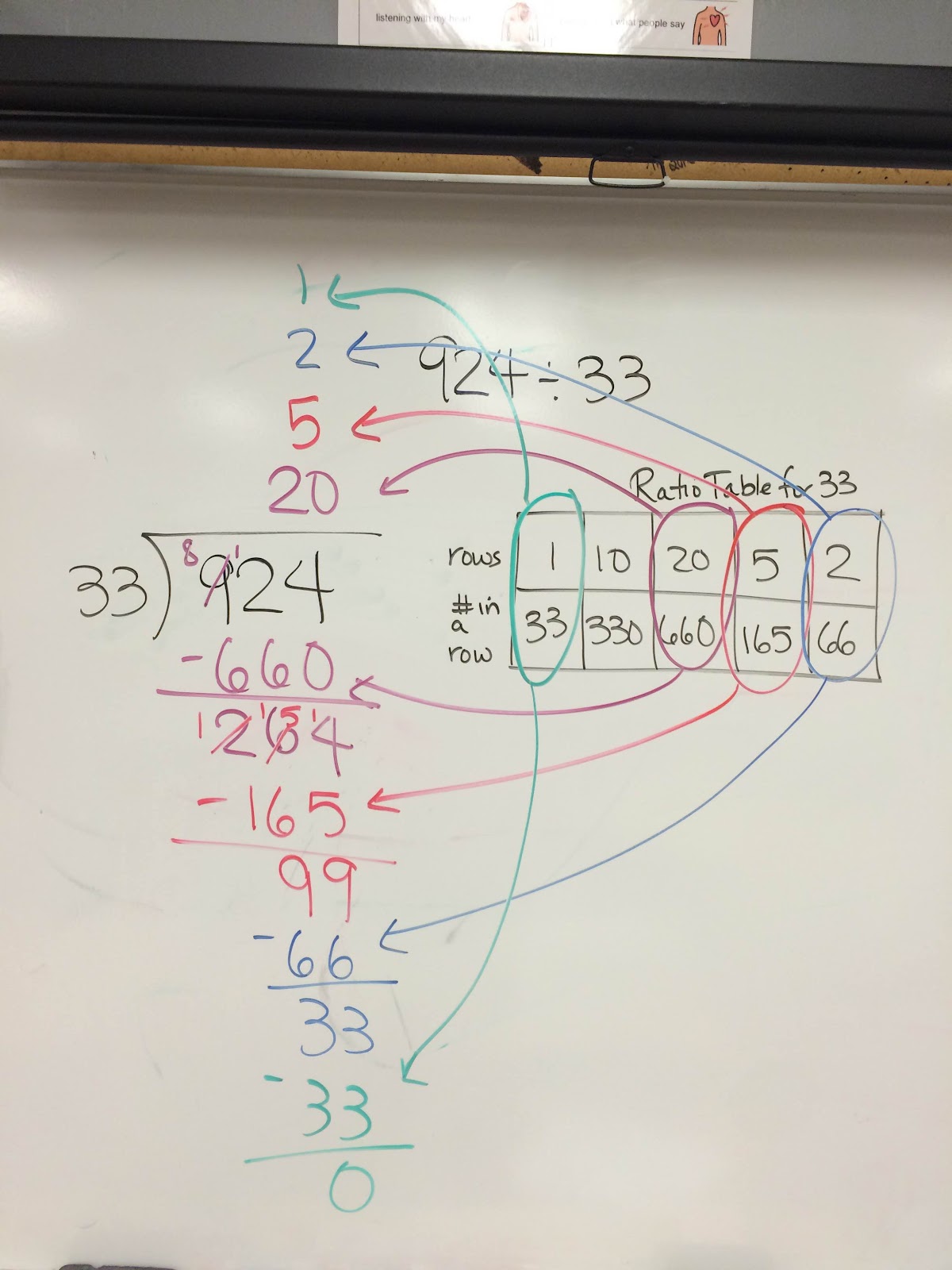
Math 5:  We continued practice with multidigit multiplication by doing a lot of repetitive practice on the front end of each class period. Many more students are finding success with the standard algorithm for multiplication.  Don’t be afraid to lob one in during a post dinner conversation!  We dug deeply into new strategies for division and are slowly progressing towards the standard algorithm for division.  This week we connected the ratio table to the partial quotient strategy.  If you view the model in the picture below, your child might be able to help you bridge one strategy to another.


Partial Quotient.JPG


Math 6:  Deeper investigations into Variables and Patterns …  As we continue to use tables and graphs to ask questions, find solutions, and compare one set of data to another, students are becoming fully proficient in how to graph a set of data and how to create a set of data from a graph.  We analyzed situations where a graph might be a better representation than a table.  Also we were introduced to data in a journal format and had to try and figure out how to make a set of data from notes.  All of the learning in this unit focuses on a group of students starting a bike tourning business.  This has provided the glue for all of our problem solving.  We also began graphing our water chemistry from the trout aquarium, which allowed to begin telling the story of “what is happening and why”, as well as the results of those chemical changes.  Interesting stuff!
Models of Molecules.JPG
⅚ Science:  This week we were heavy on investigations and on models.  Our week was spent heating and cooling liquids, then solids, then gases.  How could we build a model that explains, on a molecular level, what is happening in a thermometer, with a brass ball that has been heated, and with air when we warm it up?  Below is a snapshot of some early ideas of modeling that allow us to understand the “nano” level of molecular movement.  


Students watched a fun video last week...they loved it.  See link if you have a ½ hour.https://www.youtube.com/watch?v=cm-vkMGqkMQ&safe=active


The Week in Ms. Wesnak’s Room (⅞ Humanities):


This week has been filled story-telling!


Our morning classes have been focused on work for our Memoir Writing Project. Each day students were given in class work time to complete their 5 paragraph memoir. We talked about how using detail is important in a memoir, but that a memoir can become too wordy if you are using too many details that are not truly important to the focus and development of the story. Students practiced using their “writing filter” by coming up with 6 Word Stories. The most famous 6 Word Story was written by Ernest Hemingway. He wrote, “For Sale: Baby Shoes, Never Worn.” We discussed what made this a story, and we tried to create our own 6 Word Stories. This activity challenged students to pick out the details that mattered because they were only allowed to use 6 words. We also did a mini grammar study on the ever-feared semi-colon. Students learned the most common way to use a semi-colon, which is to join together 2 independent clauses. We watched a fun instructional video, practiced as a class, and had some independent practice as well. Students will be asked to use this newly developed writing practice in their memoir. The week ended with a partner peer edit, and the classes sharing out great examples of detailed/5 senses writing.


During the afternoons our classes took our final journey back in time to World War 2. Students performed their World War 2 Point of View projects, and they have been fantastic! Due to these projects we have had a wide variety of “guest speakers” in our classroom. Students took on the roles from World War 2: U.S. soldiers, teacher, mothers, a spy, russian soldiers, german soldiers, families in hiding, presidents, scientists, and pilots. These projects were impressive with the students use of costumes and props. Through thoughtful and creative performances students carefully shared their gained knowledge from our World War 2 studies. We wrapped up the performances on Friday and were even able to begin work on our next unit: The Business Convention! Students are getting really excited for this trimester long project, and I can’t wait to get started!


The Week from Ms. Q’s Room (⅞ Math & Science):


CMP8
This week began with the completion of our Function Junction Unit Test.  We left function notation to reexamine algebraic equalities in a new unit called “Say it With Symbols”. Using the distributive and commutative properties we worked to solve more sophisticated algebraic expressions.  We plan to do only a few investigations in this book to increase our level of solving equations of all types of problems.(quadratic, linear and exponential)  It is also a great review of showing the steps we use for solving multi-step problems.  We will be taking a pause from math as we begin our SBAC testing.


CMP7
Students worked on using symbols(variables)  to represent a variety of numbers in i algebraic equations.  We used drawings and variables to balance equations with  pouches and bags from the country of Montarek.  As a class we are learning a variety of strategies to balance equations and the important practice of showing our steps.    Next week we will be pausing math work  to take the SBAC test.


Science 7th/8th
Creating light stations for Friday’s light experiment lab was the order of business this week.  Each small group pulled a light concept from the “Cylinder of Fate”.  These topics included diffraction, reflection, refraction, electromagnetic spectrum, concave and convex lens, mirrors, 3-D, optical illusions,  and polarized lenses . We will be taking a pause from science as we begin our SBAC testing window.

Friday, March 20, 2015

Week of March 16th - 20th

TA’s Notes:
SBAC (Smarter Balanced Assessment Consortium) Testing Schedule:
7th & 8th graders- April 1st, 2nd, 3rd, 6th, 7th & 8th
5th & 6th graders- April 30th, May 1st, 4th, 5th, 6th & 7th
Please have students get a full night’s sleep prior to testing days, eat a good breakfast and be ready to come to school to try their best!  A sign-up sheet to bring in healthy snacks throughout testing times will be e-mailed out next week. We understand that the 7/8 testing window overlaps with the school Musical, so we will have makeup times for those involved.


WillistonRuns! for Education
Calling all runners, walkers, riders- let’s build some Voyager House spirit and get together for some fun on Saturday, May 16th at the WillistonRuns event!!!  
WillistonRuns! is a 5k run sponsored by FAP to benefit all the kids in Williston schools. You can run it, walk it or ride it but the most exciting option this year is the 5k team event.
Voyager House would like to put together as many 3-person teams as we can to run the 5K race;  we can invent some crazy team names, wear crazy team costumes and have some crazy fun, beating out all the other houses to win the “House with the Most Teams” or the “House with the Fastest Team” title. We want Voyager House to sweep the event!
Last year the event raised over $2,700 to support field trips and classroom enrichment. This year we want to be part of raising even more.  Let’s show our Voyager House team spirit and register some teams!
For more info and for online registration, check out the website here:   http://willistonruns.org/


Paper registration forms are also available at the front office at WCS.


Thanks and let’s get moving!
___________________________________________________________________________
WCS Dialogue Night: Wednesday, April 1st 6:00- 7:45pm in WCS Dining Room
Ever wonder what middle schooler kids REALLY think about …feeling a sense of belonging, peer pressure, mean behavior, binge drinking, inhalants, tobacco, teen depression… Here is your chance to find out!  For the pizza part of the evening, 6-6:15PM, please RSVP to Sarah, SAP Counselor, sklionsky@cssu.org or 871-6079, by Monday 3/30
____________________________________________________________________________
FAPAC March Meeting Highlights
The FAP Advisory Council held its monthly meeting on March 12th.  Please check the full minutes on the school website in a PDF format by clicking HERE.  Below are a few meeting highlights:


Big Basket Raffle Fundraiser and Fun Night on Saturday, March 28th:  One Week to Go — Thank you for all your donations to the classroom baskets.  Baskets will be collected from classrooms on Friday, March 20th and transformed into the beautiful wrapped baskets that are raffled off on Saturday, March 28th.  Doors for this event open at 6:00 p.m.  This is an Adult-Only Event.  Fun Night, sponsored by Full House, is taking place the same night for children in grades K-4; registration info has been in the School Bell and is in both Main Offices.   There are still some spots available on the sign-up sheet for the Basket Raffle; specifically, we need help selling raffle tickets, bringing in items for our refreshment table, and cleaning up at the end of the evening.  If you can help with any of these things, please go to this   SIGN UP LINK    


Jump Rope for Heart on Friday, March 27th — WSD's annual Jump Rope for Heart will take place at Allen Brook School the morning of Friday, March 27 from 8:45-11:15 am. Participating WCS students will be bused to ABS in the morning and brought back to WCS after the event is over.  Children in grades 1-8 can participate in the event. Signed permission slips should be handed in to a physical education teacher. Registration deadline is Friday, March 20 or when we reach the maximum capacity of 375 students (whichever comes first).


Online Donations to Annual Fund — the online feature for making donations to the Annual Fund will not be available after March 31st.  You can still send checks in through the Main Offices or the House T.A.s.  The online feature will resume for the start of the next school year.


Voyager’s Giant Indoor Sale on Saturday, March 21st — Shop tables full of donated treasures! Household goods, Clothing, Accessories, Sports Equipment, Toys, Art, Electronics, Collectibles & More! Food Concessions too!  On Saturday, March 21st 9am - 2pm at Williston Central School's Cafeteria.   Please donate items to the sale on Friday March 20, 6-8 pm. Clean out your clutter and help students at the same time!  To help out at this event sign up HERE


Special thanks to the Variety Show Committee (Shelley Forrest, Danielle Trasciatti-Holmberg, Susan Willis) for organizing an amazing show on Friday, March 13th.  And kudos to all the individuals who performed in the show!  It was a great evening of entertainment.  Such a talented community we have!!!


Consider attending one of our meetings.  Meetings are the 2nd Thursday of every month at 8:15 am in the WCS Dining Room.  Thanks.


The Week in Mr. Merrill’s Room (⅚ Humanities):
    This week in AM Humanities, students continued their Narrative Writing piece. Students were asked to write a short narrative that takes place during the American Revolution, to strengthen their knowledge of that time period. Students created a plot map of their stories, and created a character that they would like to write about. We began writing our narratives, and will hopefully finish them up next week.
In PM Humanities, students continued learning about the American Revolution. This week, we focused on the Declaration of Independence, it’s meaning, and it’s importance. Students also re-wrote the opening of the declaration in their own words. We also introduced the American Revolution class project, a digital freedom trail! Students will work in small groups to research a relevant topic or person, and will create a website that teaches other students about their topic. We will then use QR codes and iPads to create a digital learning experience for students to explore!


The Week in Ms. Wesnak’s Room (⅞ Humanities):


This week in Humanities has been focused on starting our Personal Narratives/Memoirs and finishing up our World War 2 Point of View projects.


Our morning times together were spent completing a few journals writes to practice our memoir writing skills! Students were encouraged to use their 5 senses to trigger memories and expand their writing. We completed journal writes inspired by smell, taste, sound, and touch. Students took multiple trips down memory lane sharing funny, meaningful, and detailed stories of small moments from their past. By the end of the week all students had completed a timeline of their life, picked an event to write about for their memoir/personal narrative, and began completing their outlines. We reviewed the expectations for the writing piece on Friday, and we also reviewed the due dates. Students were told that this is a writing project, meaning that it has two parts. Part 1 is to complete the memoir, and Part 2 is to complete an iMovie connected to the memoir. The iMovie will be a series of pictures to illustrate the story (photos from the actual event or photos found online to help illustrate the event) with the audio being a read aloud by the author of the memoir itself. All of this work will be shared at our “What is my Story?” showcase that will be happening right before the April Break. It is always such a treat to read these stories, but even more meaningful to hear the students tell them!


Our afternoons have been completely dedicated to the World War 2 Point of View Project. Students have really been taking this project to the next level. The classroom is currently smelling of coffee and tea from students staining their papers to look old! We have piles of costumes from the WCS drama closet that students have found to wear for their presentations. I have been extremely impressed by the dedication, creativity, and care students have been putting into this work. It’s not an easy task to bring together the events of a world war, but students have been using an array of resources from their own research notes taken in February, class handouts provided, Jr. Scholastic articles, and of course the powers of Google. This project is always so amazing to see in its completion because students are able to represent a variety of perspectives to tell the complete story of World War 2.


The Week from Ms. Q’s Room (⅞ Math & Science):


CMP8
Due to the concert schedule, we had an abridged week of math.  This week we looked a little more closely at the relationships parent functions and how changing the parts of the equation allow it to flip, stretch, and slide up and down and side to side.  We played a fun game of function jeopardy and ended the week with the Function Junction Unit Test.
CMP7
This class was also impacted by the concert schedule, so we reviewed some old material before forging on to new investigations.  We looked at the meaning of a solution set between two linear functions and how to write a linear equation from the y-intercept and single coordinate point.   Students finished the week with a  Moving Straight Ahead Partner Quiz.
Science 7th/8th
The beginning of the week brought a summation of our WCS engineering challenge. Students complete their final reflections and handed in their engineering templates.  We got things “rolling” with our new unit by looking at waves. Using springs and rope we explored transverse and longitudinal waves.  Students received vocabulary and readings for this unit and we dabbled in exploring the properties of light.


The Week in Ms. O’s Class
Math 5: Sorry for the delay in the update.  I was in an engineering class all day Friday and Saturday and am just coming up for air!  Students spent their week making secure their skills with the standard algorithm for multiplication and beginning work with conceptual understanding of division.  Moby Max is an expectation for the week (Mon-Sun) so please check in with your child about their 1 hour expectation.

Math 6:  Sorry for the delay in the update.  I was in an engineering class all day Friday and Saturday and am just coming up for air!  Students focused on tables and graphs this week and searched for what we call regularity in math.  What are the relationships between tables and graphs?  What can a table tell us that maybe a graph cannot (at least not directly)?  What are the advantages of a graph over a table?  And the regularity in math would be...what is true about both tables and graphs and their relationships to each other?  We did jumping jacks and situps to collect data and reinforce graphings skills and learned about the coordinate grid.  The book involves a lot of graphing...you’ll hear the uggghhhs at home.  It’s a good thing to practice, I promise!

Science ⅚:  We began our next unit, Properties of Matter, and had some interesting days of investigations with water.  Students watched an engage video in which a man pops a water balloon and captures the pop on a high speed camera and wondered, why does the water hold together?  We then observe water on wax paper, hanging from a dropper and in a glass beaker (with a drop of food dye added) in order to determine, what makes water, water?  By investigating water in these ways we were able to come together, in a scientists’ meeting, to discuss what we know about the nature of water.  I audiotaped one of the two meetings and will make this available for your listening pleasure, as a way for you to see just how bright all of these kiddos are!  To be posted soon...