Friday, November 13, 2015

Week of November 9th - 13th

TA’s Notes:
***Please do not send in any food to be shared among Voyager students***

Reminder - Grades close next Friday, 11/20. Reports will be going home on Friday, December 4.

Ms. Sherman:

THANKSGIVING BASKETS!!!
Just a friendly reminder to families that we are doing a “food drive” for Thanksgiving. Each core has a sign-up sheet for items. We hope to create 4 complete Thanksgiving baskets to donate to our local families this holiday. Check in with your children about what they have signed up for. Your child can bring in their item any time in the next few weeks and drop it in the bin, in their core classroom. Thanks in advance!!!!

The Week in Mr. Merrill’s Room (⅚ Humanities):
Monday:
             Reading Cafe
             WKET Current Events News Quiz
Tuesday:
            Worldly Wise Spelling Quiz
            Final Read Aloud for Closed for the Season and Coraline
            Completion of Setting Maps and Character Tables in Reading Response notebooks
            Investigating Map Projections Activity
Wednesday:  
             Book Fair Visit
             Guest speaker - Emily Keller former Voyager Student who has started her own non   
             profit to feed the elderly in Guatemala
            
Thursday:
             Wordly Wise Vocabulary Quiz
             Scholastic Reading - Bug Bites and Summary Writing Activity
             Mapping US Watersheds Activity
Friday:    
             Weekly Reflection Writing
             Students review map/table in Reading Response notebook for best evidence
             Evidence and analysis drafting for the final LEAF essay
             Global Village Visit (a ⅞ Voyager project)
             
The Week in Ms. O’s Room (⅚ Math & Science):

Math 5:  We wrapped up a week of learning about Least Common Multiple and Greatest Common Factor and how these numerical noticings may help us solve fraction addition and subtraction problems as well as simplify fractions.  It was good solid review for the assessment, which we took today.  On to Unit 3!

Math 6:  Students are trudging their way through some very sophisticated understanding re: ratios, rates, and their relationship to fractions.  Armed with new language and solid connections to what they already know about fractions, students are learning about equivalent ratios, unit rates, and comparisons between numbers based on multiplicative reasoning.  

Science ⅚:  It’s an Engineering Challenge!  Students were assigned groups and a problem to solve and have begun the Engineering Design Process in order to find an award winning solution to the problems.  Tasks include:  a zipline that can transport a money down an 8 meter line in 8 seconds or as close as possible; an egg bungee system to protect a raw egg from splattering on the floor; a rubberband car that can hit the target 3 meters away; and a catapult system that can launch marshmallows consistently to a target 5 m. away.  Thursday is competition day.  More details about timing of events to follow.

The Week in Ms. Wesnak’s Room (⅞ Humanities):

Global Village Excitement!  
Everyone did great- countries were amazing!  Pictures to follow in near future!

The Week from Ms. Q’s Room (⅞ Math & Science):

CMP7
In math this week we are finishing up Accentuate the Negative.  We reviewed Order of Operation and PEMDAS, learned about the distributive property using an area model, and utilized a new visual model to help students understand addition and subtraction of signed numbers. Students had the chance to play positive/negative number Bingo and the product game. We also learned about solving 2 step algebraic equations and showing your steps clearly and methodically. Next week we will complete our review and the Accentuate the Negative assessment will be on Tuesday.  Students had less homework this week due to the Global Village.

CMP8
This week we completed our Growing, Growing, Growing investigation with exploration of fractional exponents and their equivalent expressions, scientific notation operations and transformations of exponential decay and growth functions.  We rounded out the week with playing jeopardy!  We will begin our Unit Assessment on Monday.  The next unit is on the Pythagorean Theorem.

Science 7th/8th
This week’s science focus was the Global Village.  Students created Google slides about their country’s current health status, which included infant mortality, life expectancy, common diseases, common causes of death, and immunizations needed for entrance to the country.  Finally, students had to research about current travel restrictions. Friday morning we kicked off the WCS Engineering Task. Students were placed in 7th/8th groups and selected tasks such as the rubber band car, monkey zipline, marshmallow catapult and Egg Bungee.  The competition takes place on Friday, November 20th!  Go Voyager!!!!

Saturday, November 7, 2015

TA’s Notes:
***Please do not send in any food to be shared among Voyager students***

***All 8th Grade Trip Behavior and Academic Expectation Forms NEED to be in by Monday, November 9th!***

Voyager’s Book & Media Sale Today!
We still need as much help as we can get with set-up tonight and selling tomorrow!  
Tonight from 6-8pm is set-up in the Sterling hallway
Saturday we need helpers from 12:30 - 2:30 and from 2:30 - 4:30!
Thanks to everyone who has volunteered- let’s make this a crazy successful fund raiser!


The Week in Mr. Merrill’s Room (⅚ Humanities):
    Students should be very close to finishing their mystery/suspense books. We had more fun taking turns reading in character this week. Students had some great interpretations for their parts.  We have been busy collecting evidence about the setting and the characters to write a LEAF on what makes “scary” scary. We will be starting that next week.
    We have been exploring many strategies and techniques for personal narrative writing over last two weeks. This week we explored writing from a clear point of view and using details that ring true. Students spent some time doing some storytelling, telling so the listeners could experience the story with them. I have been really impressed with the writing effort in class.
    Our 5 Themes of Geography Google Slides State Project concluded today with a fun share time. Students had to explore 4 slide shows (4 states from 4 different regions) and use the slide shows to complete an exit survey of each state. The projects can be accessed via your students google account (google slides or classroom).
    FAP Book Fair - We will be going to the FAP Book Fair on Wednesday morning, if your student would like to purchase a book, this is the day to bring money.

The Week in Ms. O’s Room (⅚ Math & Science):

Math 5
  • This week students reinforced understanding of common denominator and how to use these strategies when adding and subtracting.
  • Our work in science has insisted that we learn and understand more about line graphing.  We had several lessons on the elements of good graphs and will continue to work on this until we are pros!  

Math 6
  • The introduction to ratios and how they are related to fractions is a good step in the Algebra direction.  We have had practice activities just making ratios, but also have worked on fractions of the whole problems where students are commenting on the fundraising goals of an imaginary group of students. This work has resulted in making ratio/comparison statements about the fundraising goals.

Science ⅚
  • This week we took advantage of the weather and spent all science periods outside.  In order to understand the concept of speed, we had several runners and walkers run/walk a race course; we collected data; we graphed the data; we then made sense of that data.  This week was very math heavy and revealed the need for more time working with data sets.  Statistical analysis is a lot of work!  See photos below for some insight into our learning!


The Week in Ms. Wesnak’s Room (⅞ Humanities):

Our morning classes this week have been dedicated to our 5 paragraph informational essays. Students spent about a week researching and taking notes on topics of study for their Global Village country. After our research, we took the next step in the writing process which was to build an outline. Students were given multiple options for their outlines and suggestions for how to organize all of their notes and research to build a 5 paragraph essay that they would feel successful about. Once students completed their outlines, reviewed any suggestions or feedback, they were given the green light to move ahead to begin writing their essay. Students have been spending each morning this week with their essay, and by also putting in time at home or during core, they should all be at the point to participate in a peer edit. After having reviewed some helpful hints for informational writing over the course of the week and providing students with time to self-edit their work, all students participated in a peer edit on Friday morning. Once they have applied any necessary changes and completed a final proofread students can turn in their essays in Google Classroom. The final due date is Tuesday, November 10th. For this writing piece we have been using bits and pieces of the Lucy Calkins information writing unit, so the rubric may look a little longer than previous units, but that is only because the Lucy Calkins’ rubrics go into great detail! Lucy Calkins writing units, rubrics, and check lists are being used throughout Williston Central School in all grade levels, and it is also the rubric that is used for our On-Demand writing assessments in the Spring and Fall.

8th graders have been assigned their final reading response for their literature group on “The Day of the Pelican”, and the 7th graders are completing their final reading assignment. The 7th graders will be assigned their final reading response next week, and students will also be participating in a final discussion.

Our afternoon classes have been covered in cardboard creations, paint, duct tape, glue, and costumes! We are officially in the “All Hands On Deck” mode for the Global Village as we are only one week away! Students have been working hard and really pushing their creativity by taking risks and thinking outside the (cardboard) box. We need to send a special thanks out to all of the parent volunteers that we’ve had in our classroom over the past few days. With their help we were able to set up stations and rotations for students to go to the WCS costume room and also spend time painting large pieces of cardboard and murals for their displays. We have a variety of building and landscapes in the making such as mountains from Norway and Iceland, Big Ben from the United Kingdom, and even a Parisian Cafe! We hope that you will all be able to join us next Thursday from 1:30-2:30 for Voyager’s 2nd Global Village!

The Week from Ms. Q’s Room (⅞ Math & Science):
CMP7
What rules can help you add and subtract positive and negative numbers?  What rules can help you with multiplying and dividing positive and negative numbers?  These questions preoccupied our lessons this week.  We also worked on our understanding of inequalities.  Such as
2x + 5 25.  Students solved these inequalities as equalities and worked to graph them on a number line.  These problems were challenging for students and put many into disequilibrium, which is all part of building our math thinking.  **A  special note about homework. Students should stop working on math after 30 minutes, even if they have not completed the assignments.  Thanks!

CMP8
Decay factors and decay rates; students did a lot of work around tables, graphs and equations that showed these functions.  They included things like area of a ballot, flea medication and cooling tea.  We saw that the exponential decay equation is similar to the exponential growth function, however, the decay rate is always less than 1.  Y = 200 (.80x) is an example of where the starting amount of 200 decreases by 20% each year, however, you have to multiply each year by .8.  Finally, we had some jasmine tea and watched the decrease of temperature over time using our new GoTemp temperature probes and the Graphical Analysis app.  

Science 7th/8th
This week students were working diligently on researching a genetic abnormality or disorder.  Their goal was to create a brochure that was accessible to a general audience and that explained the symptoms, genetic causes and treatment of the disease.  They also learned about which chromosome, gene was responsible for the disorder and how it was passed on.   Students shared their information on these diseases with each other. Next week we will be giving up science for the Global Village Project.  Each country will have some specific health questions that they will research as a science component of their project.

Friday, October 30, 2015

Week of October 26th - 30th

TA’s Notes:
***Please do not send in any food to be shared among Voyager students***

Voyager is sponsoring the Book & Media Sale at the Craft Fair again, Saturday, Nov. 7th here at WCS.  We can only make a profit if we have good merchandise to sell.  Please start gathering books and other media (DVDs, Videos, Music CD's, old records, puzzles) and send them in with your students or place them in the large collection boxes located in front offices of both WCS and ABS.  We are storing them in the Voyager Project room.

We also need volunteers to set-up and sell during the Craft Fair.  Responsible students can help with this!  We ask for at least one adult to be present during a block with students selling.
Please sign up here:​
Dates to Remember:
December 9th:  Voyager Family Night 6-8pm
March 26th: Voyager Recycle Sale
May 6th: Voyager Dance

The Week in Mr. Merrill’s Room (⅚ Humanities):
Students are settling into our Reading Cafe Monday routine. Many students are able to “get lost” in their books and are building their reading stamina. In our literature group books, we focused on characterization this week. For our reading practice, students selected a character and read in character - this was a lot of fun. We also started to identify the scary characters and how the author reveals them to us.
We continued our Narrative writing work, learning about strategies for generating personal narratives and using them to write a story. Students are recording these strategies and techniques in their Writer’s Notebooks, and brainstorming ideas as well. By this point, students have 2 - 3 different stories that they have written in their notebooks. Sharing stories is always a great part of the class.
During our afternoon Humanities time, students took an assessment on the 5 Themes of Geography, matching themes to real geography situations. We also started a 5 Themes Google Slides project this week. Students were grouped by region and  selected a state to make a theme based slide show. We spent some time in the library and online (using library electronic resources) researching with organizers due on Tuesday next week.

The Week in Ms. O’s Room (⅚ Math & Science)

Math 5:  Students are working with ratio tables in very sophisticated ways.  We have learned that the ratio table strategy is versatile enough to: solve multidigit multiplication problems, simplify fractions, answer questions like “what is the better buy?”, predict future values like if tomatoes cost $2.35 per pound, how much will it cost to get 5 pounds?, and find common denominators for fractions when one must add or subtract them.  I

On Monday, students will be bringing home their first unit work.  Please be looking for it.  This will give you a chance to see actual unit assessments and entrance and exit tasks as well as all the other stuff.  

Math 6:  This week we began our new unit, Comparing Bits and Pieces. See the Parent site linked here:  http://mymathuniverse.com/programs/cmp3/channels/8.  This whole unit is on the bits and pieces or fractions of numbers.  There is a strong emphasis on ratios. I will provide a lot of additional information to students on this topic.  This week we began looking at “for every” statements as a way to compare numbers.  For every 11 girls there are 10 boys. This statement compares the number of boys to the number of girls.  

On Monday, students will be bringing home their first unit work.  Please be looking for it.  This will give you a chance to see actual unit assessments and entrance and exit tasks as well as all the other stuff.  

⅚ Science:  We completed our unit on electricity and magnetism and are now full steam ahead in a force and motion unit.  Our anchoring phenomenon was this...students were invited to a fancy dining table arranged with glasses and plates and candlesticks and flatware.  They are about to get down to business and eat their Thanksgiving dinner, when a man on a motorcycle backs up, ties the tablecloth to the back of the motorcycle and steps on the gas!  He swipes the tablecloth out from beneath the dishware and the meal continues on!  We all know this trick, but what is the science behind it?  The unit will work to explain that phenomenon and many others!  To begin...Students collected data on things in motion and worked to explain the question, how do you know that something is in motion?  We then engaged in a stations approach to learning, but pushing and pulling, or applying forces, to things to put them into motion, or to cease motion.  It was fun!
IMG_3386.JPG

IMG_3388.JPG

IMG_3389.JPG

IMG_3391.JPG


The Week from Ms. Q’s Room (⅞ Math & Science):

CMP7
This week we have been wrestling with positive and negative numbers and strategies to add and subtract them.  We continue to utilize visual models and began to form rules for working with inverse operations.  For example: When you add a number you can subtract it’s opposite and when you subtract a number you can add its opposite. Students played several fun card games including “25” where students added and subtracted positive (black) and negative (red) card values to get to 25. They also played positive and negative integer war in teams of two.  

CMP8
8th graders explored the relationship between growth factors and growth rate by looking at population change and compounded interest.  We compared exponential growth when starting values varied and utilized strategies to find the y intercept of our exponential functions when our tables began with an “x” value of 1.  We looked at Vermont’s population and the very low growth rate of  .02%.  We  figured that it would take over 3,400 years for Vermont to double it’s population at its present rate.  Students began a partner quiz and finished the week with an exponent card game.

Science 7th/8th
We began the week with a quick review of meiosis and spent time investigating the Learn Genetics website through the University of Utah.  We took a tour of all the components of genetics, including: DNA, chromosomes, genes, traits, proteins and heredity.  We surveyed the class to see what dominant and recessive traits our class possessed like tongue rolling, eye color, hair color and many others.  We discussed how traits are passed from parents to offspring.  We graphed the class data to see the prevalence of specific traits in class. Finally, we completed an investigation on dragon inheritance. We selected chromosomes from a male and female dragon to produce a baby dragon with all sorts of traits, like horns, fire breathing, spiked tails and varied color.

Saturday, October 24, 2015

Week of October 19-23

TA’s Notes:
***Please do not send in any food to be shared among Voyager students***

Voyager is sponsoring the Book & Media Sale at the Craft Fair again, Saturday, Nov. 7th here at WCS.  We can only make a profit if we have good merchandise to sell.  Please start gathering books and other media (DVDs, Videos, Music CD's, old records, puzzles) and send them in with your students or place them in the large collection boxes located in front offices of both WCS and ABS.  We are storing them in the Voyager Project room.

We also need volunteers to set-up and sell during the Craft Fair.  Responsible students can help with this!  We ask for at least one adult to be present during a block with students selling.
Please sign up here:​
Dates to Remember:
December 9th:  Voyager Family Night 6-8pm
March 26th: Voyager Recycle Sale
May 6th: Voyager Dance

The Week in Mr. Merrill’s Room (⅚ Humanities):
We had our first independent Reading Cafe on Monday. Students read an independent book and updated their Reading Response notebooks. We encouraged students to read deeply and build reading stamina during the school year. We also kicked off our new literature round - Mystery and Suspense. 5th graders are reading - Closed for the Season and 6th graders are reading - Coraline. Students will have weekly reading assignments and will be working in their Reading Response notebooks - gathering evidence, tier 2 words,  and reading strategies. This week we discussed the literary device - setting and we drew a picture of the setting and made connections to how it enhances the mood of the book. Next week we will be working on character maps.
Narrative writing will be our next writing unit. We started by asking students to write their best “small moment” story and dig deep to use writing strategies that they have used in the past. Writer’s workshops will begin next week.
We also continued our review of the 5 Themes of Geography. We created word maps for many land and water forms including: isthmus, strait, sound, gulf, canyon, and archipelago. We wrapped up the week with an exciting game of jeopardy that reviewed all of the themes. Next week students will have an assessment on the themes and start a theme based project.


The Week in Ms. O’s Room (⅚ Math & Science):

Math 5:  Fifth graders worked this week on taking the understanding of clocks, money and fractions and addition and subtraction to the next step: Adding and Subtracting with common denominators.  For some students, this is a return to a generalization they have heard before - that you must have common denominators to add or subtract fractions.  But for others, this is still a developing understanding.  The clock and money models provide a great opportunity for understanding addition and subtraction of fractions.  If you have the problem ¾ + ⅕, you can use money to solve this problem.  ¾ = 0.75 and ⅕ = 0.20, so you will end up with 0.95!  But how does this relate to common denominator?  Well, 0.75 = 75/100 and 0.20 = 20/100, so 75/100 + 20/100 = 95/100.  And there you have the common denominator!  This is an easy example but it is the jumping point for discovering how to find a common denominator for any pair of fractions you are adding or subtracting.

Clarification:  Each month we have a rotation of learning.  The first two weeks are spelling/vocab and the second two weeks, students are given time in school to work on Moby Max.  Students are still asked to do one hour per week of Moby Max, even on the vocab weeks.  Please encourage your child, during vocab weeks, to work on their online math learning!  These are the weeks that the scores have been lower!  Also, when students play their math games on Moby, those minutes don’t count towards their overall minutes for the week.

Math 6:  We finished up Prime Time this week by reviewing the last 6 weeks of learning and taking our final assessment.  We will be cleaning out our work from the unit and sending it home on Monday.  Please look out for this work!

Upcoming Due Date:  The Prime Time Number Story is due on Monday.  Ask your child to make sure they are making the final touches on their story.  They all received feedback on their story from both me and two peers.  

Clarification:  Each month we have a rotation of learning.  The first two weeks are spelling/vocab and the second two weeks, students are given time in school to work on Moby Max.  Students are still asked to do one hour per week of Moby Max, even on the vocab weeks.  Please encourage your child, during vocab weeks, to work on their online math learning!  These are the weeks that the scores have been lower!  Also, when students play their math games on Moby, those minutes don’t count towards their overall minutes for the week.

Science ⅚:  We wrapped up our electricity and magnetism unit this week by finishing our vocabulary word maps and preparing and taking an assessment.  We have learned so much!  Students mapped a series of new Tier III words from this unit by defining the words and then describing the association or relationship between those words. They are really impressive especially due to the fact that they were not allowed to use the internet.  Their understandings all came from experiences in the classroom and even they were surprised at how much they have learned.  We hope you saw last week’s photos on the exciting telegraph stations we set up.  The telegraphs, made by Dan Fleming, our engineer in residence, were a great way for students to see how the science of electromagnetism, was applied to a real life, engineered mechanism, that changed the technology of communication.  We had two telegraph stations separated by 50 ft of wire over which we sent electrical pulses, or dots and dashes, just like people in the mid 1800’s.  It was cool!

Coming up:  VEEP, Vermont Energy Education Program, is coming to our classroom on Tuesday!  A great extension to our learning about motors and generators.  I am speaking to the VEEP rep this weekend about timing, but I will let you know in case you want to drop by!


The Week in Ms. Wesnak’s Room (⅞ Humanities):

To start our week in AM Humanities students continued their work with Ms. Baker by creating their individual art pieces for our large art installation which will take place the week before Thanksgiving. Keep an eye out for a formal invitation in your email! As we moved through our week we continued our work with informational writing by beginning our Global Village work and forming our families. Students took a look at a great time lapse video from one man’s travels around the globe. He travelled to 17 different countries over the course of 348 days! Working with their families, students picked their countries for the Global Village. This year we will have families from countries such as Iceland, Egypt, Thailand, and more! Students also got started on their research for their informational writing piece. This will be a 5 paragraph essay and each student will be writing about a specific topic in regards to their country. Some of the topics include: People, History, Geography,and The Arts. Students are really pushing and building their research skills, as they are not allowed to use Google yet! We have spent 2 of our classes so far in the library, and students have been finding some great information and taking strong notes. Students are really having to dig through the books and readings to find answers. They are also having to think critically and creatively in order to pull and synthesize information from a variety of sources. This has been great practice in researching and is providing the students with a wealth of information and knowledge for the Global Village!

Our afternoon classes were dedicated to reflecting on the Model United Nations debates, and building a bridge to our Global Village Unit. Students were put to the challenge with their Global Village families to participate in the Global Puzzle Simulation! Students were given a 550 piece jigsaw puzzle to solve in a 40 minute class. There were many restrictions given to the students as well, such as they couldn’t talk, they couldn’t see the cover, they had time limits, and at the end of their class period they had to break down all of the work they had done. The purpose behind this simulation was to showcase all aspects of problem solving on a personal level and a global level. On the personal level this was a great way for our Global Village families to bond and work together to solve a common problem by using all members of the group. On the global level this was a great way to simulate how it is important for all countries to work together, and to understand that each country represents a separate piece in the global puzzle. By having students not be able to talk, this was a great way to simulate how when there are people from different countries trying to communicate to solve problems, it can be difficult to get ideas across fluently and completely with common understanding. The puzzles themselves represented global problems, and by not giving the students the cover to the box of the puzzle they were left not knowing what the outcome or solution would look like. Students had to guess and make predictions as to what the solution to their problem would look like, much like what happens in the real world. Sometimes, you just don’t know what problems will come your way or what the exact solution is going to look like in the end. Overall, we had a great experience and students really enjoyed this simulation! We are all very excited to continue on our global journey!
The Week from Ms. Q’s Room (⅞ Math & Science):
CMP7
This week we began our investigation into positive and negative integers by using different models such as number lines and red and black chip boards. We did a fun experiment where we placed an ice cube in water and graphed the progress using our new Go Temp! Temperature probes.  Our question was whether the temperature change was linear or nonlinear. We also looked at temperature moving in a negative direction and formed an equation to show our results.
CMP8
Mold growth, invasive plant species and Burmese pythons were the order of business this week in math class as we explored exponential functions in nature.   Through the week we formulated the exponential growth equation which is y = a (bx), where “a” is the y intercept and b is the growth factor.  So for example in Hurricane Katrina if 100 pythons were released by mistake, at a growth factor of 1.5, you would triple your number in three years.  It is frightening! Students also created crafty exponent rule books to refer to as we work through our exponential growth unit.
IMG_1064.JPG
Science 7th/8th
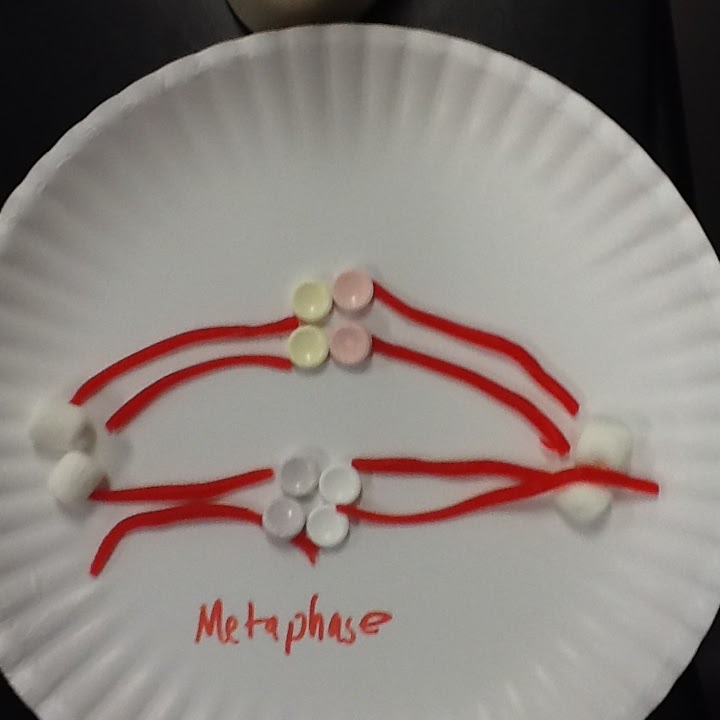
This week we began with making models of the phases of the cell cycle which included interphase, mitosis and cytokinesis.  Students had different pieces of candy from Twizzlers, Smarties, marshmallows and Skittles to form a nuclear membrane, centrioles, spindle fibers and the chromatids.  We took pictures of our steps and labeled the process in which our cells divide to make identical copies.  We had a Cellular Biology and Microscopy Review doing a speed dating format where students moved around the room to form dyad pairs to discuss compelling topics like: “How to focus a microscope?” or “How are plant cells and animals cells similar and different?” We completed our unit test.  Our next mini-unit will be on genetics and heredity.  Be prepared for questions and surveys about traits that your family may possess.


IMG_1065.JPG

Monday, October 19, 2015

Week of Oct 13th - 16th

TA’s Notes:
***Please do not send in any food to be shared among Voyager students***

Book & Media Collection
Voyager House will be organizing the book and media sale at this year's Craft Fair, Nov. 7th.
Please consider donating:
  • Gently used best sellers or decent books (no textbooks or dated ‘travel’ books)
  • Children's chapter and picture books
  • Music CD's
  • Movie DVD's
Items can be dropped off in Voyager’s Project Room or bins at WCS & ABS
Any questions, please contact Katie Fieldsend at KFieldsend@cssu.org

Save the Date:  Wednesday, December 9th- Voyager Family Night 6-8pm

FAP UPDATE
The FAP Advisory Council held its first monthly meeting of this school year on October 8th.  FAP is Williston's equivalent of a parent-teacher organization.  We meet each month, our meetings our open to all, and you will receive an email like this every month with highlights of the meeting and a link to the FAP website for the full minutes.  Check the full minutes in a PDF format by clicking HERE.  Below are a few meeting highlights:

Administration Report:  Greg Marino, our District Principal, talked about communication strategies for our schools, including Facebook and Twitter, about SBAC results which families of current 4th-8th graders should have received in the mail in the last 10 days and the exciting new Disk Golf Course.  Please check the full minutes for more information on these topics.

Williston Annual Fund:  This fund pays for your children's school field trips, among other educational items.  Current donations total $10, 328, which is less than one-third of our target.  So PLEASE SEND IN YOUR DONATION TODAY or you can do it online by clicking HERE.

Educational Grants:  FAP approved nearly $7,500 in educational grants for enhanced learning activities in our Williston Schools.  Please check out the full minutes for more information on this.

24th Annual Craft Fair at Williston Central School -- Saturday, November 7th, 9:30 am to 4:00 pm:  This first big FAP fundraiser is attended by hundreds of area residents.  We welcome back both crafters who come year after year and many new crafters this year.  AND the Media/Book Sale is back, sponsored by Voyager House!  We also need your help with this event; opportunities to help SET UP, HELP CRAFTERS UNPACK VEHICLES, AND HELP SERVE FOOD TO CRAFTERS.  WE ALSO NEED HELP IN THE KITCHEN THIS YEAR!!  Please CLICK HERE if you can donate an hour or two of your time to this event.  THANK YOU!

Scholastic Book Fair in the Williston Central School Dining Room — Monday, November 9th-Friday, November 13th:  Look for more information on this important school fundraiser in the School Bell.  This event needs parent help too!  Whether you want to help set up, clean up or help with sales in 2 hour shifts during the week, whatever time you can dedicate is appreciated.  Here is the SIGN UP LINK.

Parent Presentation:  How to Understand and Reduce Anxiety in Children with Dr. Paul Foxman, Ph.D., Tuesday, November 10th from 6:30 – 8:00 in the WCS Auditorium:  Join us for an evening with psychologist and anxiety expert, Dr. Paul Foxman, Ph.D., Founder and Director of the Center for Anxiety Disorders in Vermont, and author of The Worried Child and Dancing with Fear.  Dr. Foxman will help parents learn:  How, why and when anxiety develops in children: The different forms of anxiety; What parents can do to reduce stress and anxiety; and When and how to refer for professional help.  If you need additional information about this event, please contact Chris Ford, WCS Guidance Counselor at cford@cssu.org.

Our next meeting is on Thursday, November 12th at 8:15 am at Williston Central School.  We hope you can attend!!!

The Week in Mr. Merrill’s Room (⅚ Humanities):
Students worked really hard on their LEAF Constructed Responses this week. The question - what are the characteristics of a hero? Is Malala a hero? Defend your answer. We dug deep into our Reading Response Notebooks for evidence from our read aloud of the book I Am Malala. Students brainstormed characteristics of a hero and matched those characteristics up with Malala’s actions for the evidence of their paper. We also worked on including a well connected lead, analysis, and a finisher. Self/peer assessments using a LEAF rubric, followed by self/peer editing were the final components of our drafting process.
Our field trip to the Grand Isle Fish Hatchery was a great way for us to kick off our Trout in the Classroom project. We learned about each stage of the process which we will be doing once our eggs arrive in January on a smaller scale.
Students also had a chance to watch the ⅞ Model United Nations debates. Students represented countries and debated current hot topics. The ⅚ students enjoyed watching and were asked to take a stand on the topic being debated.
Also, ask your student about the country coordinates competition and finding exact location!

Copy of IMG_1009.JPG
IMG_1013.JPG


IMG_1015.JPG
Displaying image.jpg

The Week in Ms O's Room:
Displaying image.jpg

The Week in Ms. Wesnak’s Room (⅞ Humanities):

Due to our incredible students being extremely dedicated to their Model United Nations debates, we do not have any “Tweet the Week” statements, but here is an overview of our classes.

During our morning classes we have been getting started on our class literature groups and beginning our Global unit! For our literature groups, 8th graders are reading “The Day of the Pelican” by Katherine Paterson, and our 7th graders have just started “The Hunger Games” by Suzanne Collins. Both classes will be focusing on themes of social justice and social injustices. 8th graders have already read 100 pages in “The Day of the Pelican” and completed a written response to their reading. Students have also been following a character of their choice and keeping track of their actions, emotions, and personal choices. Based on the notes students took in their books for their reading, we began creating character maps to represent their character of study. During the rest of our classes we have been talking about informational writing. What does it mean to write an informational piece? What are some forms or types of informational writing? Where can informational writing be found? These are just some of the questions we have been tackling in class. To answer these questions we have been digging into informational texts to see what makes them different from other pieces of texts. We have also found that informational writing includes a lot of facts and data, so we have been practicing our note-taking skills and discussing note-taking strategies. Students practiced their note-taking skills by watching the global adventure of “The Secret Life of Walter Mitty” and discussing its connection to our unit and its big themes. Students have also been practicing taking notes on informational videos and nonfiction text by taking part in a postcard unit using a program through Scholastic called Global Trek. Through the program students have been able to “travel” around the world exploring different countries of their choice and building information postcards. These postcards will be on display during our Global Village in November.

Our afternoon classes have been extremely focused on researching and building arguments for our Model United Nations debate. I have been SO impressed with the level of dedication, professional attitudes and behaviors, and the overall high level of preparedness from our 7th and 8th grade community. Their arguments and debates have been clear, concrete, creative, supported, and strong. Their voices have been confident and they have been quoting statistics, data, historical evidence, and using current events to help build arguments and create resolutions. We are extremely proud of all of their hard work! Enjoy the photos!
image.jpg
image.jpg
image.jpg

image.jpg


image.jpg
image.jpg

image.jpg
The Week from Ms. Q’s Room (⅞ Math & Science):
CMP7
The last two weeks students have been concluding the geometry unit Shapes and Designs.  We created a class record that captured our understanding of the properties of polygons.  We played an exciting game of jeopardy and then completed the Shapes and Designs Unit test.  Our next area of study is positive and negative integers.  We investigated our number system by defining different sets of real numbers which include, natural, whole, integers, rational, and irrational numbers.  This puts us in a great place for exploring positive and negative numbers and mathematical operations which utilize them

CMP8
After completing the Thinking with Mathematical Models Unit Test, we took a pause to review Order of Operations and exponent rules.  Being more familiar with exponents is very helpful  while learning about and working with exponential functions.  We investigated math problems with voting ballots and a fictional reward scheme using rubas. (Kingdom of Montarek’s currency) We explored exponential functions through graphs, tables and equations.  We began to formulate ideas around growth factor and patterns in a table and graph.  

Science 7th/8th
The 7th/8th graders having been working hard to grasp how cells allow materials in and out of their semi-permeable membranes.  We did several experiments around diffusion and osmosis.  We had a very smelly situation in my classroom as we timed how long it took for each student to smell our Mango Passion air freshener.  We were able to see a linear trend in time and distance from the source.  We also discussed how scent diffuses from higher to lower concentration.  We shifted this idea to our Gummy Bear lab.  In this exploration we utilized a gummi bear as a model for a cell and placed it into several different solutions; salt water, sugar water and plain water.  We found that different solutions caused water to enter and to leave the Gummy bear, just as water leaves and enters the cell through a process called osmosis.  We finished the week with a quick overview of cell division. Using stained onion tip cells we searched  for different stages of mitosis.  Students reviewed in Google Classroom a unit overview for the upcoming test on Wednesday.